Mildew or mould on a basement wall
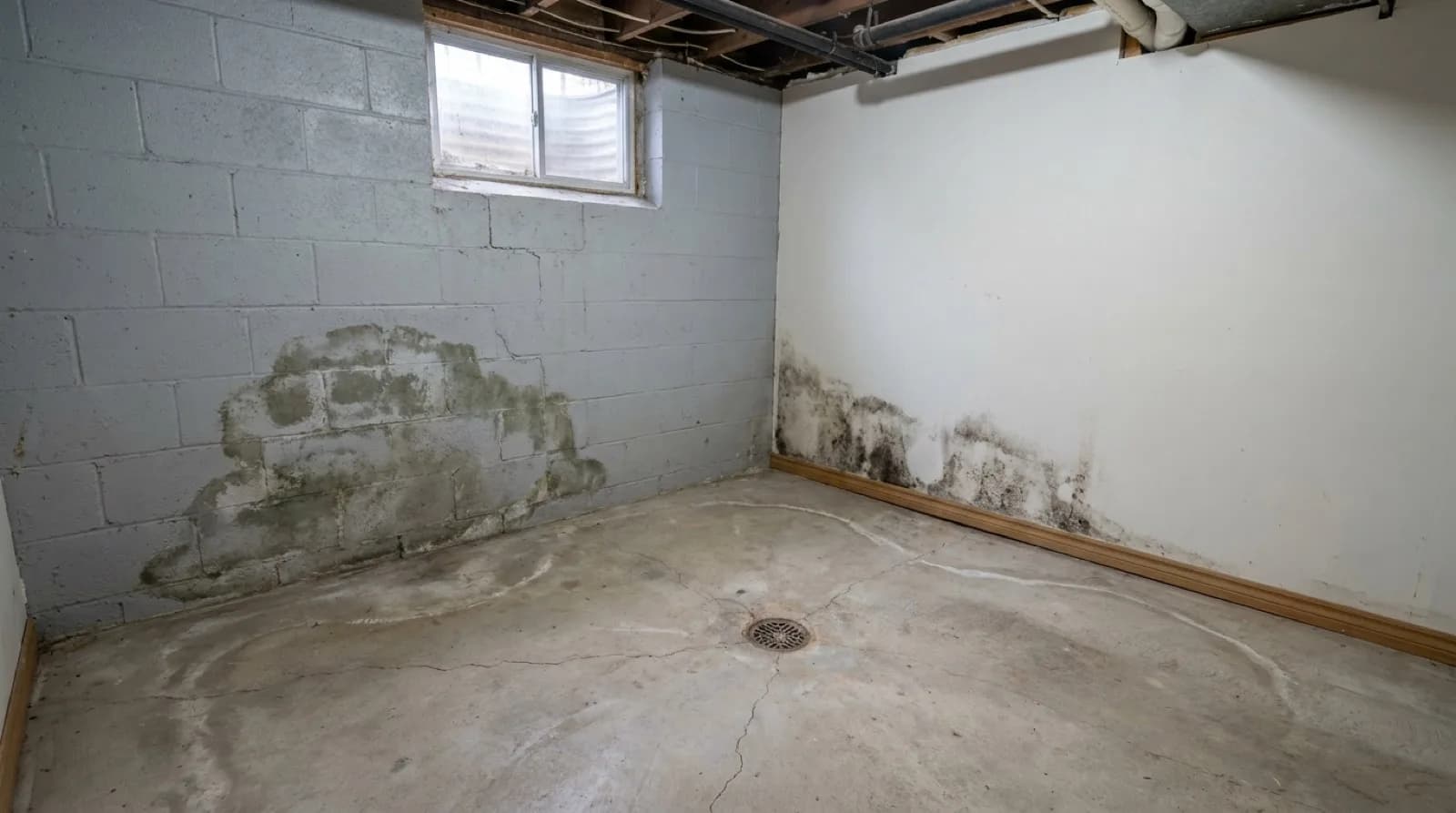
For a homeowner, mildew and mould are one problem: Health Canada recommends cleaning up any visible mould regardless of type and sets no health-based exposure limit. What changes the job is the wall. Growth on painted concrete or block can be washed. Mouldy drywall and insulation often must be cut out, and tear-out plus rebuild carries most of the bill.
Page last updated: By The RestorationIndex Desk
Key facts
- 01Health Canada recommends cleaning up any visible indoor mould regardless of type and proposes no health-based exposure limit, so the mildew label changes nothing.
- 02Non-porous surfaces such as glass, metal, plastic and vinyl can be cleaned; drywall with mould under the paint is removed and replaced.
- 03Wright Restorations prices an unfinished basement with mould on block at $1,500 to $4,000, and a finished basement with mould behind drywall at $8,000 to $25,000 or more.
- 04Health Canada says a homeowner can usually clean small and medium areas, under three square metres in total, with unscented soap and no bleach. A single patch over three square metres needs a professional.
What is the difference between mould and mildew on a basement wall?
For deciding what to do, there is no difference. Health Canada's Guide to Addressing Moisture and Mould Indoors says it "recommends controlling dampness indoors and cleaning up any visible mould regardless of the type of mould present." The guide adds that Health Canada and other internationally recognized organizations "do not propose a health-based exposure limit for mould exposure indoors", so there is no level below which growth is declared acceptable.
Mildew is an everyday word, not a category in that guidance. People use it for flat, pale surface growth. The guide does not use the split, and neither does contractor pricing, which follows the material under the growth. The question of which species is on the wall, and what a black mould label adds to a quote, is covered in black mould versus everything else. The useful question is a different one: is the growth on something that can be washed, or inside something that has to come out?
Surface growth or growth inside the material
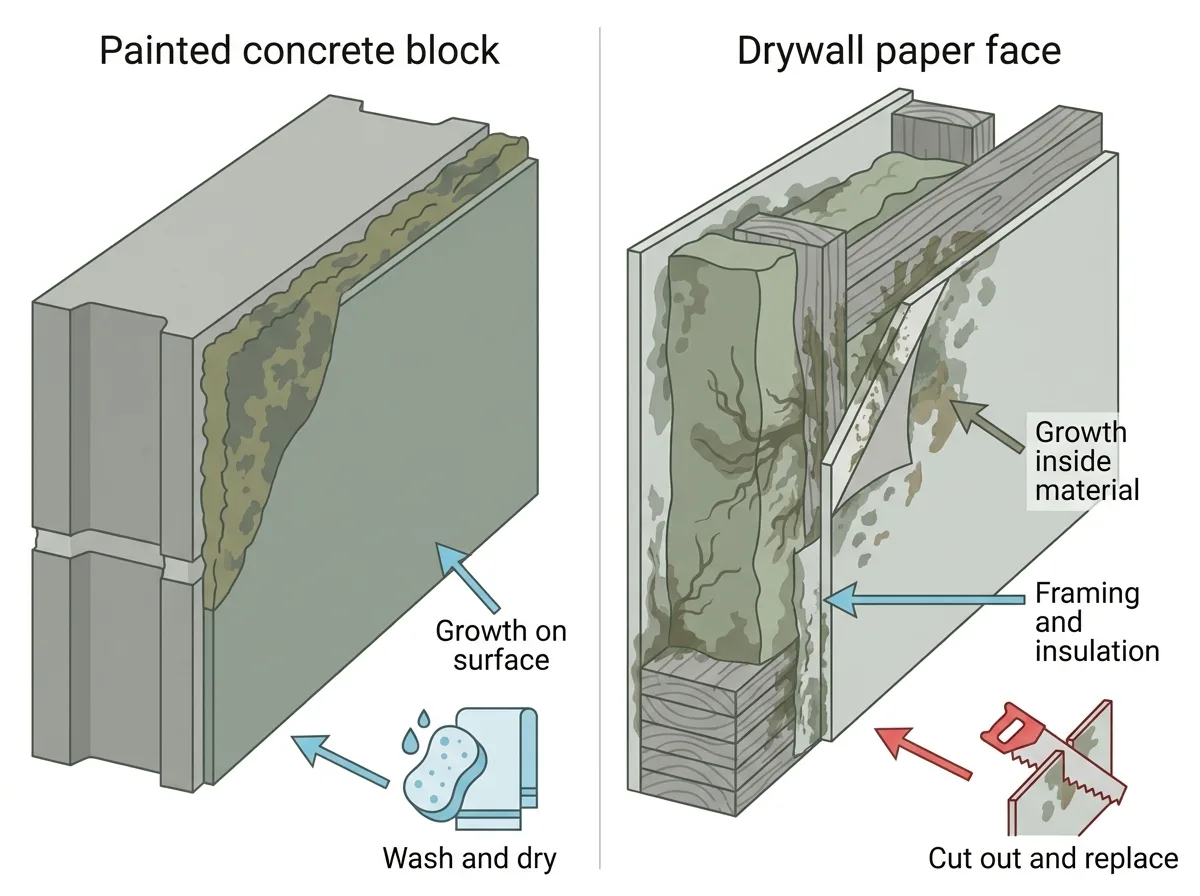
The material under the growth decides the method. Health Canada's guide says materials with mould that can be properly cleaned "must be non-porous, such as glass, metals, leather, plastics and vinyl." Porous materials often have to be thrown out, it says, and drywall with mould under the paint has to be removed and replaced.
On a basement wall the practical test is what the wall is made of. Growth on painted concrete block or on the face of a poured foundation is a surface problem. Growth on the paper face of drywall or in fibreglass batts has gone into porous material that often has to come out.
Bleach is where the two cases get confused. Health Canada's guide says plainly: "Do not use bleach to clean up mould." CPR24 Restoration explains why it fails on porous material: the chlorine cannot get into the material and leaves the deep growth alive, while the water in bleach feeds what remains.
When Health Canada says a homeowner can clean it
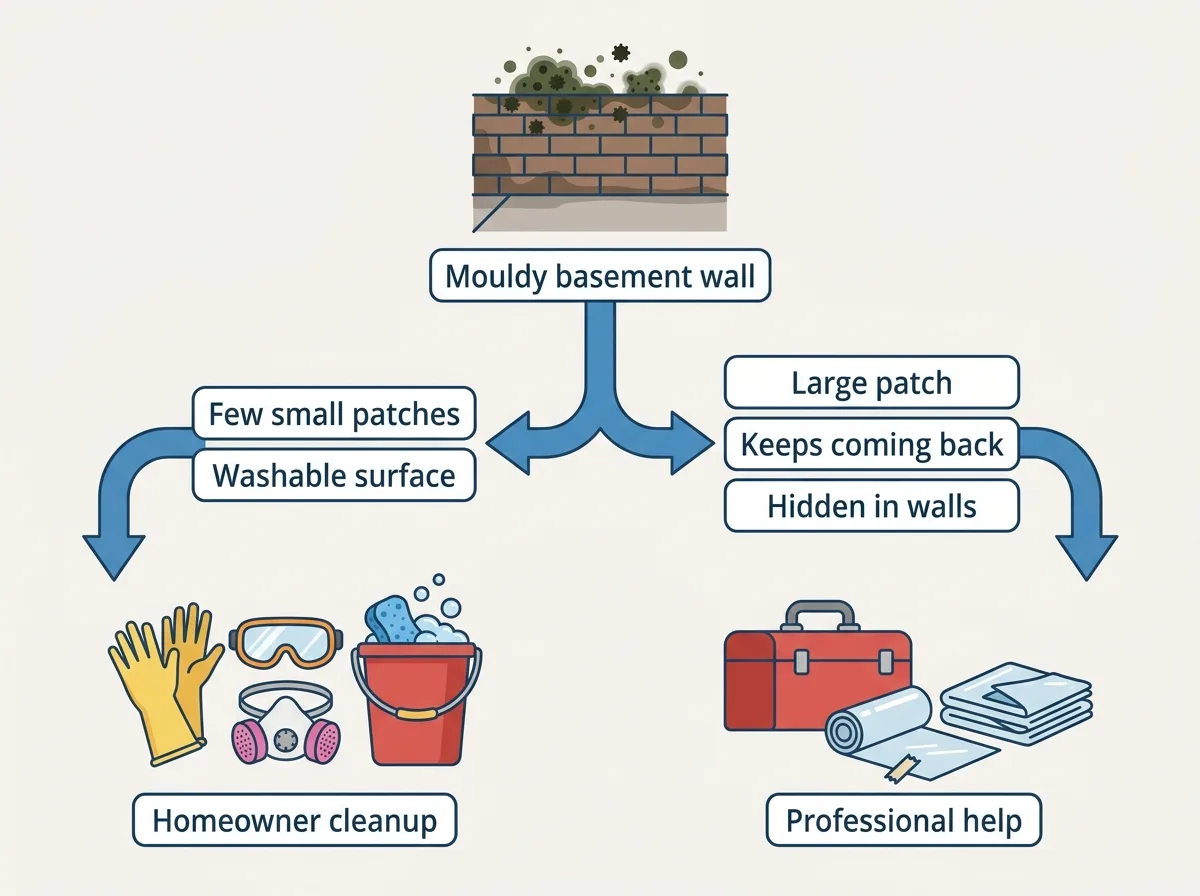
The guide sorts patches by size, in metric. A small area is three or fewer patches totalling under one square metre, about 10.8 sq ft. A medium area has more patches but stays under three square metres in total. The guide recommends a professional assessment, but "in most cases" a homeowner can clean it "without involving a professional." For the cleanup, it lists goggles, household disposable gloves and "a disposable well-fitting N95 respirator", a mask that filters fine particles. It says to scrub surfaces "with an unscented soap solution and dry completely and quickly." The 10 sq ft rule often seen online comes from the US EPA, not Health Canada.
The guide lists six cases that need a qualified professional, and three matter most on a basement wall. The first is "a single patch of mould that measures larger than three square metres", the large tier. The second is mould that "returns following cleaning", a sign the moisture source is still there. The third is suspected "hidden mould contamination inside walls or above ceilings." Mould that has come back after two cleanings meets the second case without anyone measuring it.
The guide also says that infants, children, seniors, pregnant people and people with respiratory conditions such as asthma "should not be in or near the area where the mould is being cleaned up." A smell with nothing visible is a separate question, covered in a musty smell with no mould in sight.
What surface mould costs to clean
The small job on a washable wall is cheap, and the respirators are the main outlay. United Canada Inc. lists a 10-pack of 3M 8511 N95 respirators at $38.99, roughly $3.90 a mask.
Hiring someone for the same patch costs more. Ultimate Mold Crew says professional mould removal in Toronto can start around $500 for small jobs, and it prices small bathroom projects at $500 to $1,500. Mold Busters quotes more for bathroom mould: $1,500 to $3,000.
The limit on this route is the material. Washing drywall leaves whatever is inside the board untouched.
What mould inside drywall costs to fix
Once growth is inside the wall, the space decides the price. Wright Restorations prices an unfinished basement, with mould on concrete block walls and exposed framing, at $1,500 to $4,000 in its text ($5,000 in its table). It puts a finished basement with mould hidden behind drywall at $8,000 to $25,000 or more once demolition and full reconstruction are included. Restoration Mate prices basement mould remediation at $2,500 to $8,000. The gap between the unfinished and finished cases is the drywall, flooring and built-ins standing in front of the mould.
Wright Restorations' guide puts standard drywall and framing treatment at $3.50 to $5.00 per sq ft. Finished spaces need demolition before treatment and reconstruction after, it says. Ultimate Mold Crew says Toronto companies often charge $10 to $30 per sq ft for professional remediation, air filtration and post-removal cleaning. CPR24 Restoration's cost guide puts drywall replacement at $2 to $6 per sq ft. The full set of published ranges is on the Toronto mould removal cost guide.
Reading which job a quote describes
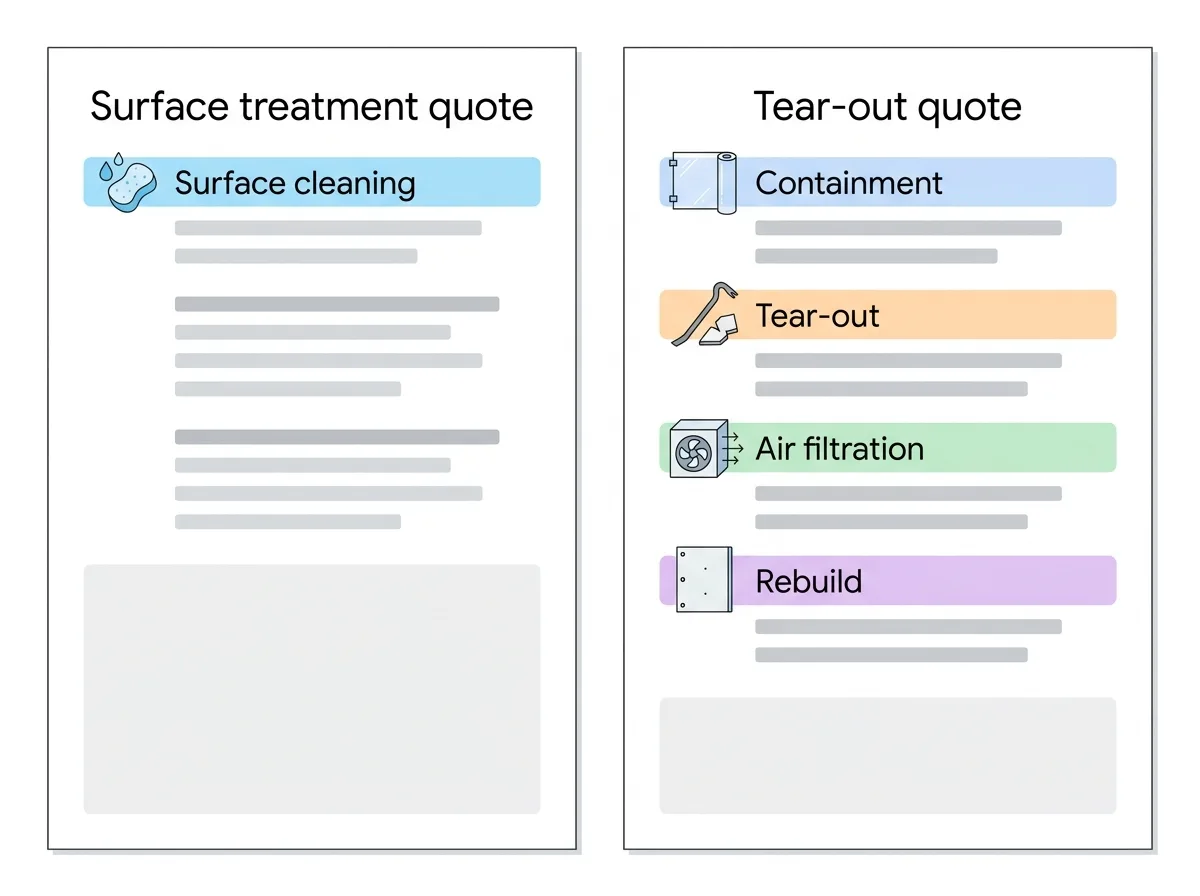
Containment is the line that separates a wall wipe from a project. Mold Busters prices containment at $300 to $2,500 depending on the size and complexity of the job. Containment means plastic sheeting, a zippered entry and fans that pull air out of the work area so dust does not drift into the house. Check whether each quote includes it before comparing totals.
A tear-out quote should also say which materials are leaving the building and whether rebuild is included. For a larger job, The Mold Guy prices a post-remediation clearance test at $200 to $400, the step that checks the work after it is done. The Canada Revenue Agency lists Ontario's HST (harmonized sales tax) at 13%, so check whether each quote includes it. When the choice is still between doing it yourself and hiring, the DIY versus professional comparison lays the two routes side by side.
The moisture source decides whether it comes back
Neither cleaning nor removal fixes the reason the wall was wet. Health Canada's guide says: "Unless the cause of the moisture problem has been identified and solved, mould will reappear." It recommends running a dehumidifier in damp areas such as basements and keeping relative humidity between 30% and 50%. The dehumidifier size calculator matches a unit to the space.
The repair behind the wall is a separate line from the mould. Wright Restorations prices foundation crack injection at $500 to $2,000 and sump pump replacement at $800 to $1,500, and says the mould returns without that correction. What happens after a flood, when the wall got wet all at once, is in stopping mould after the water is gone.
The City of Toronto runs a Basement Flooding Protection Subsidy toward backwater valves, sump pumps and related drainage work. It funds flood prevention, not mould removal. Renters have a separate route. The City's property standards page tells tenants to speak to the landlord first and, "if this issue is not resolved in a timely manner, contact 311."
What the index can and cannot tell you
Of the 294 companies in this index, 200 are listed under mould removal and 59 under mould inspection and testing. Both labels appear on 49 records, and 10 appear only under inspection and testing. Each profile shows a rating, review count and opening hours where the record has them, plus a quote request. Today 17 records carry no rating and 0 carry no hours.
What the records do not hold is the thing that matters most on this job. Ontario has no licensing for mould remediation, so anyone can advertise it, and the index stores no certification, licence status or job history. The voluntary benchmark is certification from the IICRC (the Institute of Inspection, Cleaning and Restoration Certification, the trade's standards body). Its S520 standard sets out how mould remediation should be done. Ask for it and check it.
Before calling anyone, measure the patch, photograph it, and note what the wall is made of. A few small patches on painted block is a homeowner job under Health Canada's guide. A patch over three square metres, growth that keeps returning, or growth in drywall and insulation calls for a quote. That quote should say which materials are coming out.
How this page was made: the RestorationIndex Desk compiled it from public Google Maps records and the named sources above. RestorationIndex orders listed companies by a published formula, sells no placement, and passes each quote request to one of the highest-scoring companies listed in the requester's area.
Frequently asked questions
Is mildew different from mould?
- Not in any way that changes what you do. Health Canada tells homeowners to clean up visible mould whatever the type, and sets no indoor exposure limit. Its guide never mentions mildew. On a basement wall, the deciding question is whether the growth sits on a washable surface or has soaked into drywall and insulation.
How big a patch can I clean myself?
- Health Canada counts three or fewer patches under one square metre in total as small, and more patches under three square metres as medium; a homeowner can usually handle both. Wear goggles, gloves and a well-fitting N95, and scrub with unscented soap. One patch over three square metres, mould that comes back, or suspected mould inside a wall needs a professional.
Why does the same patch cost so much more on drywall than on concrete?
- Because drywall and insulation are porous. Health Canada says drywall with mould under the paint has to be removed and replaced, which adds demolition and rebuild to the job. Wright Restorations' finished-basement band, $8,000 to $25,000 or more, includes both. Its unfinished-basement band, with mould on block and exposed framing, starts at $1,500.
Should I use bleach on a basement wall?
- No. Health Canada's guide says not to use bleach on mould and to use an unscented soap solution instead. On drywall and other porous material, CPR24 Restoration notes that bleach can make a patch look clean while growth inside survives.
What does a professional visit cost for a small patch?
- Ultimate Mold Crew says Toronto jobs can start around $500, with small bathroom projects at $500 to $1,500. Mold Busters puts bathroom mould higher, at $1,500 to $3,000. The supplies cost far less: United Canada Inc. sells a box of ten 3M 8511 N95 respirators for $38.99, and Health Canada's cleaner is plain unscented soap.
Figures on this page, and where each one comes from
An unfinished basement with mould on concrete block walls and exposed framing can be remediated for $1,500 to $4,000 (the page's prose; its table says $1,500 to $5,000). A finished basement with mould behind drywall can cost $8,000 to $25,000 or more with demolition, remediation and full reconstruction. Standard drywall and framing treatment runs $3.50 to $5.00 per sq ft; finished spaces need demolition before treatment and reconstruction after. Foundation crack injection adds $500 to $2,000 and sump pump replacement $800 to $1,500.
Basement mould remediation runs $2,500 to $8,000.
Mould removal in Toronto can start around $500 for small professional jobs; small bathroom projects run $500 to $1,500; Toronto companies often charge $10 to $30 per sq ft for remediation, air filtration and post-removal cleaning.
Ultimate Mold Crew (Toronto), Mold Removal Cost in Toronto - 2026 Full Price Guide
Mould containment runs $300 to $2,500 depending on the size and complexity of the project; bathroom mould removal typically runs $1,500 to $3,000.
The guide gives drywall replacement as $2 to $6 per sq ft, next to a national average of $3,291 for water damage restoration.
CPR24 Restoration (Toronto), Cost of Drywall Repair Toronto After Water Damage
On porous surfaces bleach's chlorine cannot get in and leaves the deep growth alive, and the water in bleach feeds the remaining mould.
A post-remediation clearance test, with a visual check, air sampling and a final report, runs $200 to $400.
A 10-pack of 3M 8511 N95 respirators lists at $38.99 CAD.
Clean any visible mould regardless of type; no health-based indoor exposure limit; small areas (three or fewer patches under one square metre) and, in most cases, medium areas (under three square metres in total) can be cleaned without a professional; a single patch over three square metres needs one; do not use bleach; six situations need a qualified professional; keep relative humidity between 30% and 50%.
Health Canada, Guide to Addressing Moisture and Mould Indoors
If the mouldy area is less than about 10 sq ft, in most cases a homeowner can handle the job.
The S520 standard describes the procedures and precautions for mould remediation in residential, commercial and institutional buildings.
Ontario's HST rate is 13%.
Tenants with a problem in a rental unit should speak to the landlord or property manager first and contact 311 if it is not resolved in a timely manner.
The Basement Flooding Protection Subsidy covers work including backwater valves and sump pumps.
City of Toronto, Basement Flooding Protection Subsidy Program
Keep reading
Check a company before you call it
Every profile on RestorationIndex carries the hours the firm posts, its public Google review record and a quote request.
Open the directory