What mould removal actually involves
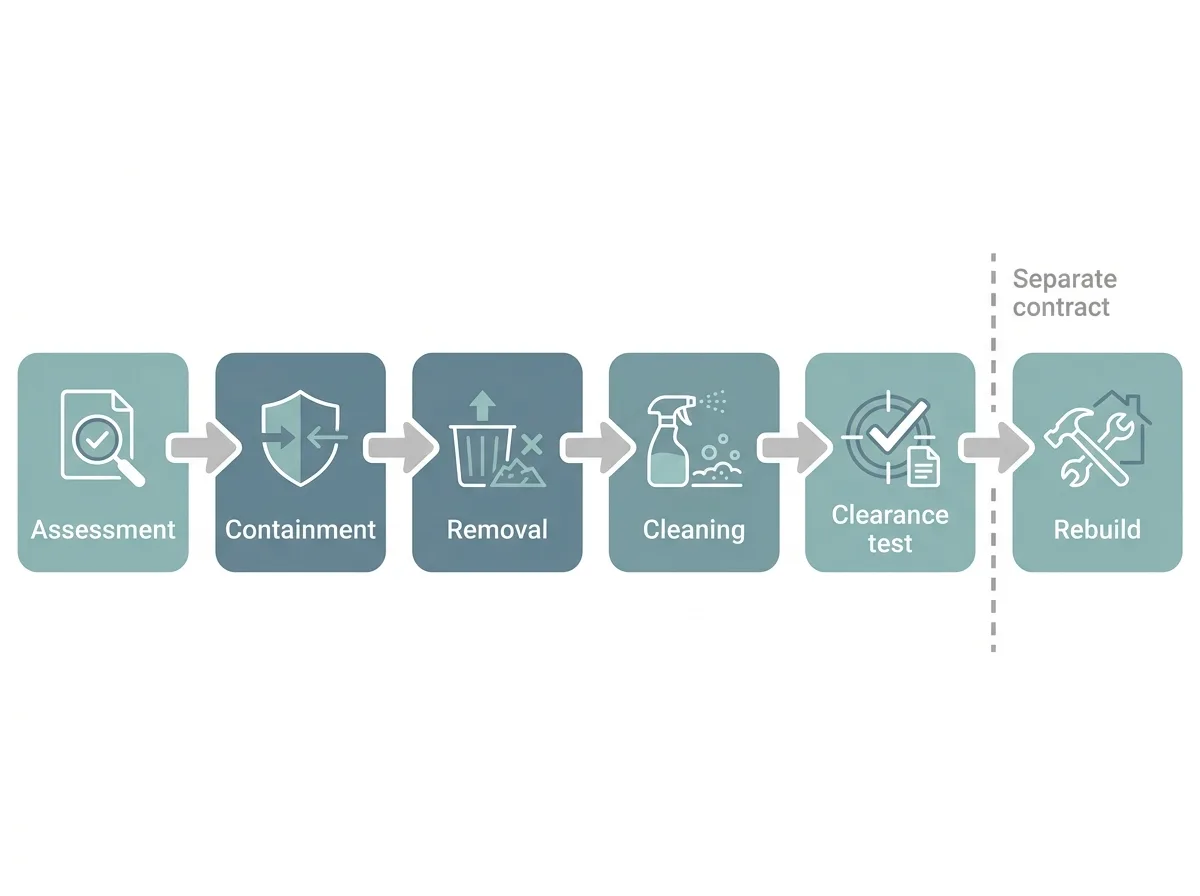
A mould removal job in Toronto runs in six steps: assessment, containment under negative air, removal of porous material, cleaning of what stays, clearance testing and rebuild. Ontario licenses no one to do this work, so the order and the line items in a written quote are how a homeowner tells a full remediation from surface spraying.
Page last updated: By The RestorationIndex Desk
Key facts
- 01Mold Busters, in a Canada-wide cost guide, lists containment at $300 to $2,500, on top of labour.
- 02Restoration Mate in Toronto lists initial inspection and testing at $300 to $800.
- 03The Mold Guy lists a post-remediation clearance test at $200 to $400. Wright Restorations puts independent accredited-lab clearance testing at $350 to $600.
- 04Of the 59 companies here listed for mould inspection and testing, 49 also list mould removal and 10 do not.
What does the Toronto mould removal process look like from start to finish?
A full remediation follows the same order whoever runs it. Someone first finds the mould and the water feeding it. The work area is then sealed and put under negative air pressure. Porous material with growth is cut out and bagged, the surfaces that stay are cleaned, and a clearance test checks the result before anyone closes the wall. Rebuild comes last and is priced separately. The voluntary benchmark is certification from the IICRC (the Institute of Inspection, Cleaning and Restoration Certification, the trade's standards body) against S520, its mould remediation standard.
The order matters because no licence stands behind it. The Professional Mold Inspection Institute, a certification school, says "there is currently no provincial licensing required to become a mold remediator in Ontario". The Mold Guy says inspectors need "no licence, exam, or government registry". What a buyer can check without a registry is a separate guide. This page covers the work itself, one step at a time, with a published price attached to each step where one exists. Of the 294 companies in this index, 200 are listed for mould removal.
Assessment: finding the mould and the water behind it
The first step is establishing where the mould is and what is feeding it. Health Canada's guide on moisture and mould explains why the second half matters: unless the cause of the moisture problem has been identified and solved, mould will reappear. An assessment that produces a scope without naming the moisture source has done half a job.
When growth is visible, a paid test often adds little. Health Canada proposes no health-based exposure limit for indoor mould. Its guide says a thorough visual inspection usually works better than extensive air, bulk or swab testing. So paid sampling fits hidden growth, disputes and clearance better than visible growth.
When growth is suspected but hidden, a paid inspection earns its cost. Restoration Mate in Toronto lists initial inspection and testing at $300 to $800. The Mold Guy prices an inspection of a condo or a home up to 2,000 square feet at $350 to $550, with moisture testing and up to two air samples. Each extra air or surface sample costs $80 to $120. The full set of rates is on the mould inspection cost page.
Size decides whether a homeowner can do the work. Health Canada treats three or fewer patches totalling less than one square metre as small. More patches, or patches between one and three square metres, count as medium, and it says most medium areas can also be cleaned safely with proper procedures and protective equipment. It calls for a professional when a single patch is larger than three square metres, when mould returns after cleaning, or when hidden mould is suspected inside walls or above ceilings. Hiring a mould removal company in Toronto walks through that size boundary in detail.
Containment and negative air
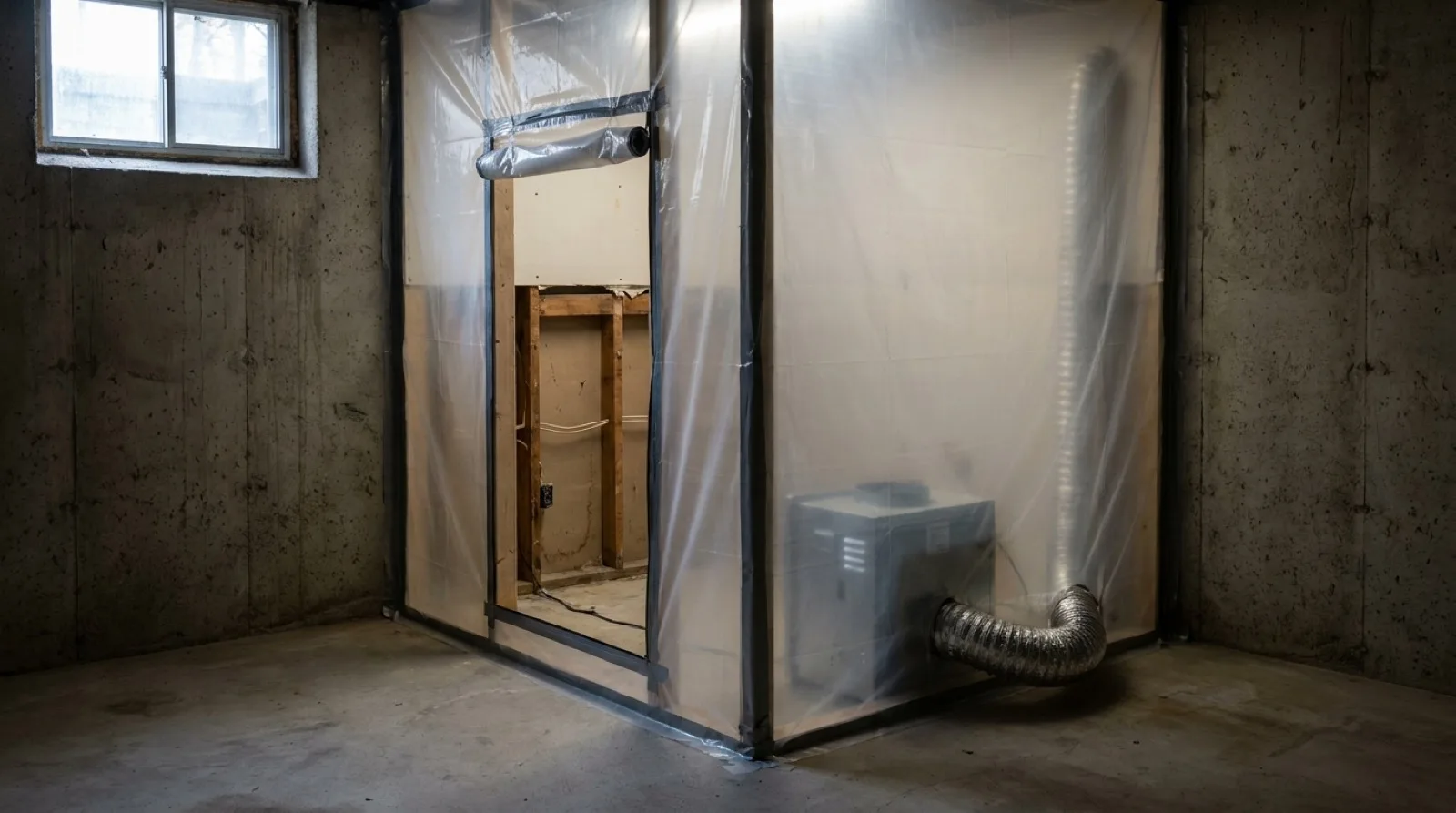
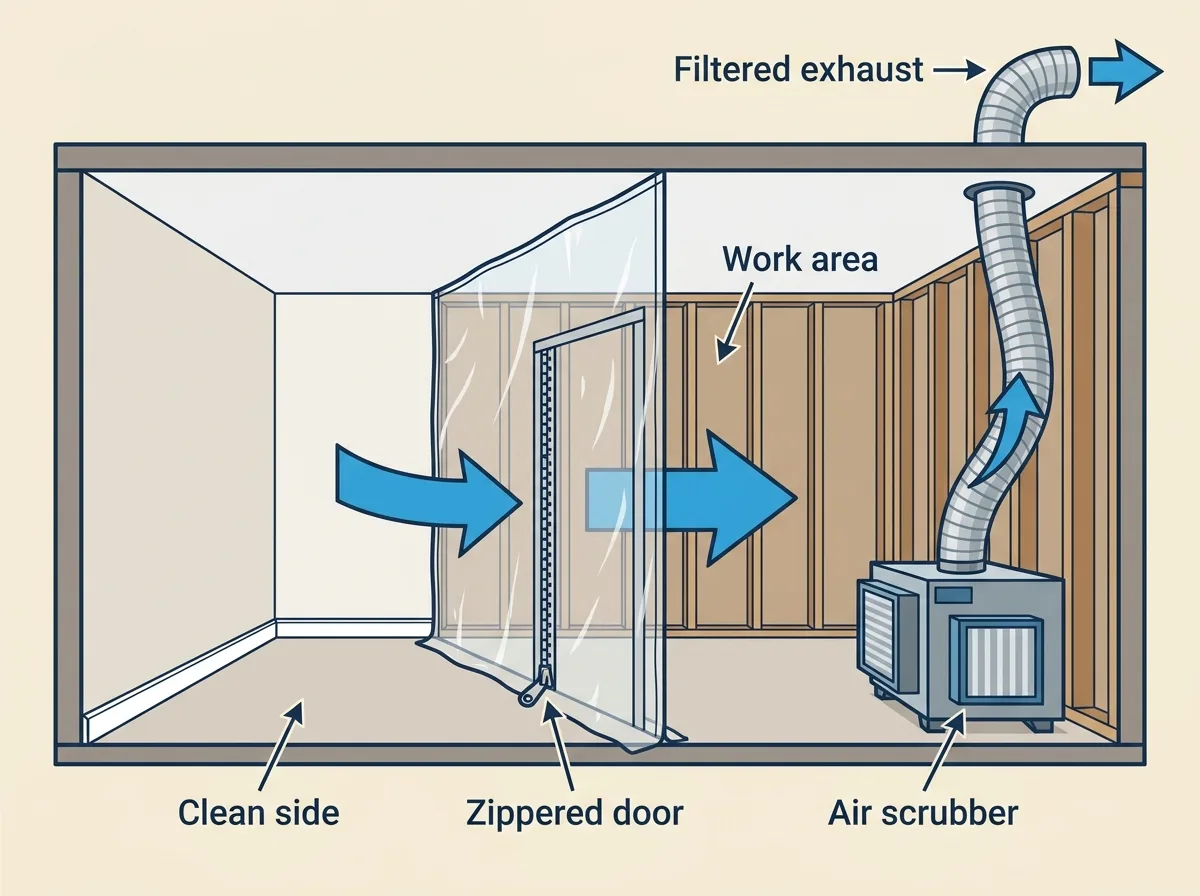
Containment is what separates remediation from cleaning. Poly sheeting (heavy plastic sheeting) walls off the work area and a zippered door controls entry. Negative air pressure, which draws air into the work area rather than out, keeps spores inside while material is cut out. Mold Busters, whose guide covers Canada as a whole, lists containment at $300 to $2,500, depending on the size and complexity of the project. It lists labour separately, at $100 to $200 per hour.
Negative air comes from air scrubbers, portable fans that pull room air through HEPA (high-efficiency particulate air) filters, and from negative air machines.
No checked GTA day rate for these machines is published here. A quote should show how many machines, for how many days.
Removal and cleaning: what leaves and what stays
Removal turns on whether a material is porous, meaning it soaks up water. Health Canada's guide says porous materials such as fabrics often cannot be properly cleaned and must be discarded. Materials that can be properly cleaned must be non-porous, such as glass, metals, leather, plastics and vinyl. In a finished basement, that usually means cut-out drywall and insulation, while hard surfaces are cleaned in place.
Mold Busters lists disposal of contaminated materials at $100 to $700. The same source lists it apart from containment and labour, so ask whether a quote with no disposal line includes it.
On cleaning, Health Canada's guide is plain: do not use bleach to clean up mould. A crew that describes its cleaning step as spraying bleach on the framing is describing something the federal guidance advises against.
The price per square foot splits by scope. Wright Restorations prices standard drywall and framing treatment in the GTA at $3.50 to $5.00 per square foot. Ultimate Mold Crew says Toronto companies often charge $10 to $30 per square foot for professional remediation, air filtration and post-removal cleaning. Why two quotes for one basement differ so much explains that gap.
Clearance testing, the step some quotes leave out
Clearance testing is the check that the work succeeded, before a wall is sealed and repainted. Wright Restorations warns that some contractors include it in their quote and others do not, so confirm which kind of quote you hold.
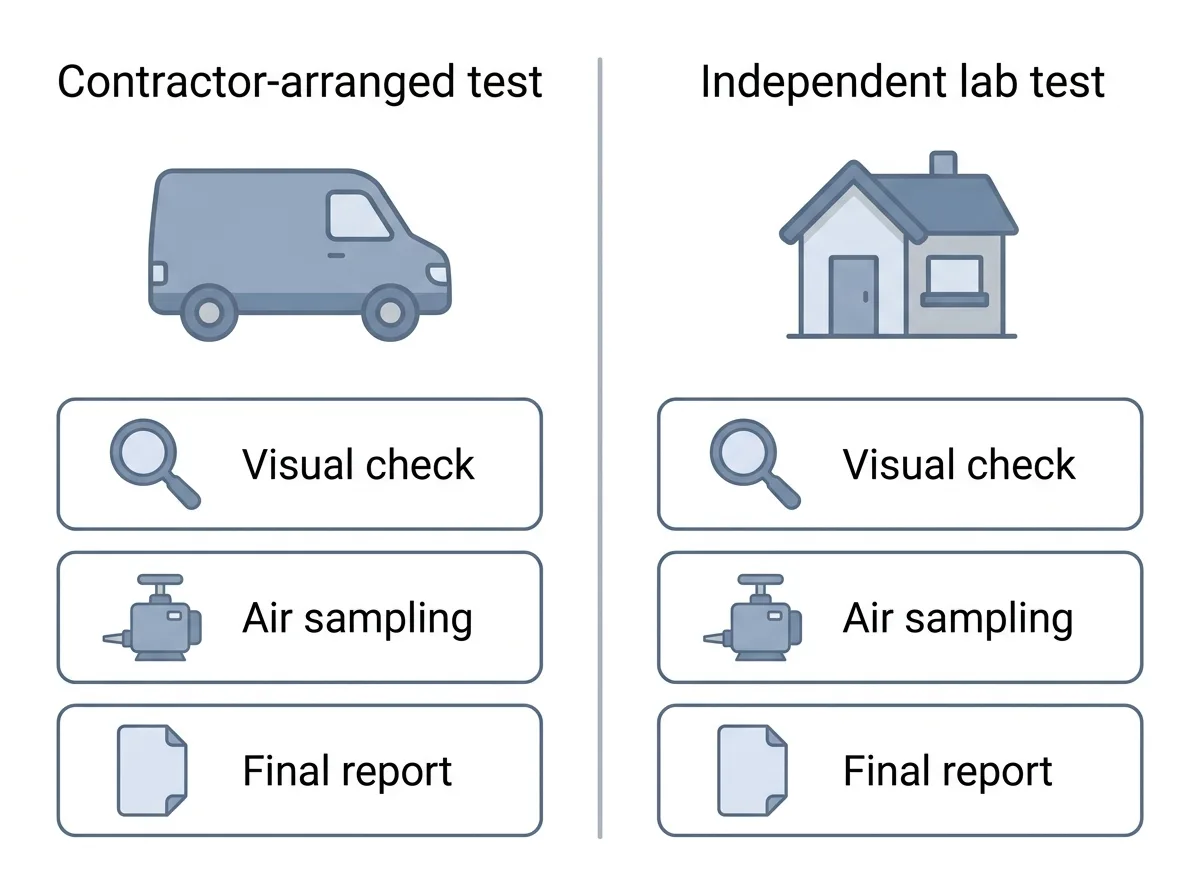
Two published prices frame it. The Mold Guy lists a post-remediation clearance test, covering a visual check, air sampling and a final report, at $200 to $400. Wright Restorations prices independent clearance air testing by an accredited laboratory at $350 to $600. It calls that test non-negotiable for insurance claims, real estate transactions and any project where health is a concern.
Independence is the point, and this index shows why it takes planning. Of the 59 companies listed for mould inspection and testing, 49 also list mould removal. That leaves 10 in the whole index that list testing without the remediation a test can recommend. That is a fact about how listings are filed, not proof of how any firm works. Arranging the clearance tester before the crew starts is easier than finding one after the wall is closed. Both clearance prices sit on the mould inspection cost page.
Rebuild and the moisture fix are priced separately
Remediation ends at bare, clean, dry material. Putting the room back together is priced separately. The mould removal cost page lists CPR24 Restoration's drywall replacement price: $2 to $6 per square foot.
The moisture repair is its own job too: rerouting a bathroom exhaust fan, waterproofing, regrading or a backwater valve. If a quote neither includes it nor excludes it by name, the cause may stay in place. Insurance narrows what any of it recovers; stopping mould after the water is gone covers the timing and sub-limits that decide a claim.
Put together, a moderate job has a typical price. Wright Restorations puts the average GTA residential project at $3,500 to $8,000. That usually covers 50 to 200 square feet, with containment, HEPA filtration, removal, antimicrobial treatment (a product applied to kill remaining mould) and testing. It excludes reconstruction of removed drywall or insulation. A quote near that band that leaves out containment or testing is describing a smaller job. Every price on this page comes from a remediation firm's own published guide; only Health Canada, the IICRC and the certification school are not remediation firms. This index records listings, not jobs: it has not watched any of these steps done and does not verify any company's certification or insurance.
How this page was made: the RestorationIndex Desk compiled it from public Google Maps records and the named sources above. RestorationIndex orders listed companies by a published formula, sells no placement, and passes each quote request to one of the highest-scoring companies listed in the requester's area.
Frequently asked questions
How long should containment stay up?
- In practice, until a clearance test passes. None of the price sources behind this page sets a number of days. Ask each firm how many machine days it assumed, so two quotes compare on the same basis.
Can the remediation company do its own clearance test?
- Nothing stops it, but Wright Restorations calls independent clearance testing by an accredited laboratory non-negotiable for insurance claims, real estate transactions and any project where health is a concern. An outside tester has no stake in the result passing. Book one before the crew starts, because most firms listed here for testing also list removal.
Is a mould test needed before the work starts?
- Usually only when the problem is hidden or disputed. If mould is already visible, the plan is removal either way, and Health Canada's guide favours a careful visual inspection over extensive air or swab testing. A paid test earns its fee when a musty smell has no visible source, or when a landlord or seller disputes the problem.
What paperwork should a mould removal job produce?
- An itemized scope before work starts, proof of certification from the IICRC (the trade's standards body), a liability insurance certificate, WSIB coverage (Ontario's workplace insurance) and a clearance report at the end. This index verifies none of these for any company, so check them yourself before signing a contract.
Can a homeowner do any of this without a company?
- Often, yes. Health Canada calls an area small when it has three or fewer patches covering under one square metre. It says most medium areas, up to three square metres, can also be cleaned safely. Wear goggles, an N95 respirator and disposable gloves, and use an unscented soap solution. Call a professional for a single patch over three square metres, mould that returns, or hidden growth.
Figures on this page, and where each one comes from
There is currently no provincial licensing required to become a mould remediator in Ontario
Mould containment runs $300 to $2,500 depending on the size and complexity of the project, labour $100 to $200 per hour, and disposal of contaminated materials $100 to $700 (Canada-wide averages)
Mold Busters (Canada), via this site's mould removal cost research
Initial mould inspection and testing runs $300 to $800
Restoration Mate (Toronto), via this site's mould removal cost research
A condo or home inspection up to 2,000 square feet runs $350 to $550, each extra air or surface sample $80 to $120, and a post-remediation clearance test $200 to $400; mould inspectors in Ontario need no licence, exam or government registry
The Mold Guy (GTA), via this site's mould inspection cost research
Standard drywall and framing treatment runs $3.50 to $5.00 per square foot, independent accredited-lab clearance air testing $350 to $600, and the average GTA residential project (50 to 200 square feet, antimicrobial treatment and testing included, reconstruction excluded) $3,500 to $8,000
Wright Restorations (GTA, 2026), via this site's mould removal and inspection cost research
Toronto companies often charge $10 to $30 per square foot for professional remediation, air filtration and post-removal cleaning
Ultimate Mold Crew (Toronto), via this site's mould removal cost research
Drywall replacement runs $2 to $6 per square foot
CPR24 Restoration (Toronto), via this site's mould removal cost research
Small mould area: three or fewer patches under one square metre in total; medium (more patches, or one to three square metres) can in most cases also be cleaned safely; a professional is needed for a single patch over three square metres and for returning or hidden mould; porous materials often must be discarded; no bleach; no health-based exposure limit
Health Canada, Guide to addressing moisture and mould indoors
S520 is the IICRC's Standard for Professional Mold Remediation
IICRC (Institute of Inspection, Cleaning and Restoration Certification)
Keep reading
Check a company before you call it
Every profile on RestorationIndex carries the hours the firm posts, its public Google review record and a quote request.
Open the directory