Clean, grey or black water in your basement
Where the water came from decides whether soaked material gets dried or thrown out. Toronto pricing follows that split closely. The Sewer and Drain quotes a Category 1 clean-water job at $2,500 to $4,000 and a Category 2 grey-water job at $4,000 to $6,500, while published Toronto Category 3 black-water figures run from $4,000 to $30,000 or more.
Page last updated: By The RestorationIndex Desk
Key facts
- 01IICRC S500 classes sewage as Category 3, and under that standard porous materials are removed and discarded rather than dried in place.
- 02The Sewer and Drain prices Category 1 clean water at $2,500 to $4,000, Category 2 grey water at $4,000 to $6,500 and Category 3 black water at $6,000 to $12,000 or more.
- 03Clean water does not stay clean: standing water picks up contamination, and a Category 1 loss left alone arrives as a Category 2 or 3 job with the whole price step attached.
- 04Sewer backup and overland water are optional Ontario endorsements, commonly capped at $10,000 to $30,000 per ThinkInsure, which sits below the top of the Category 3 range.
What the three categories describe
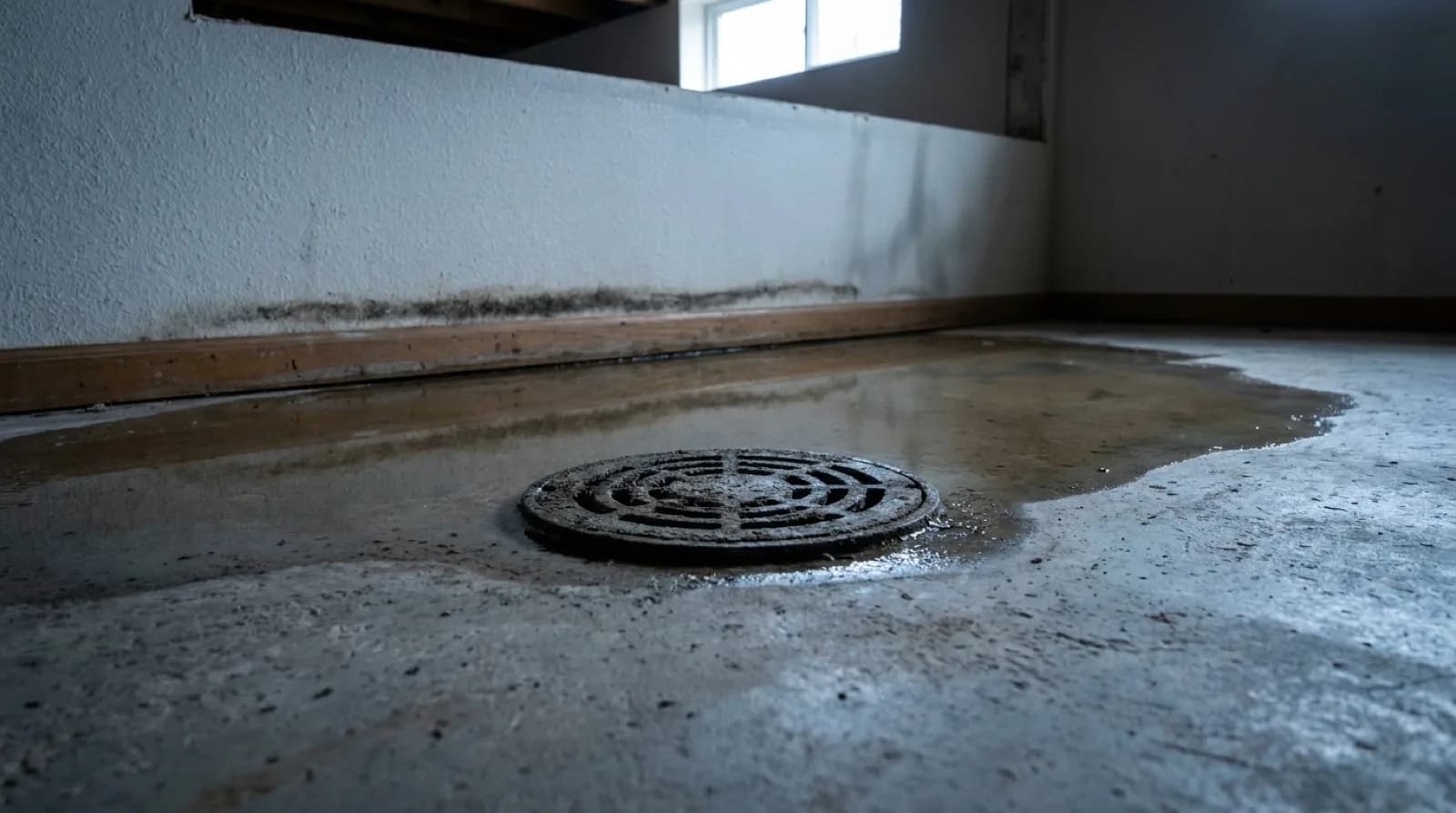
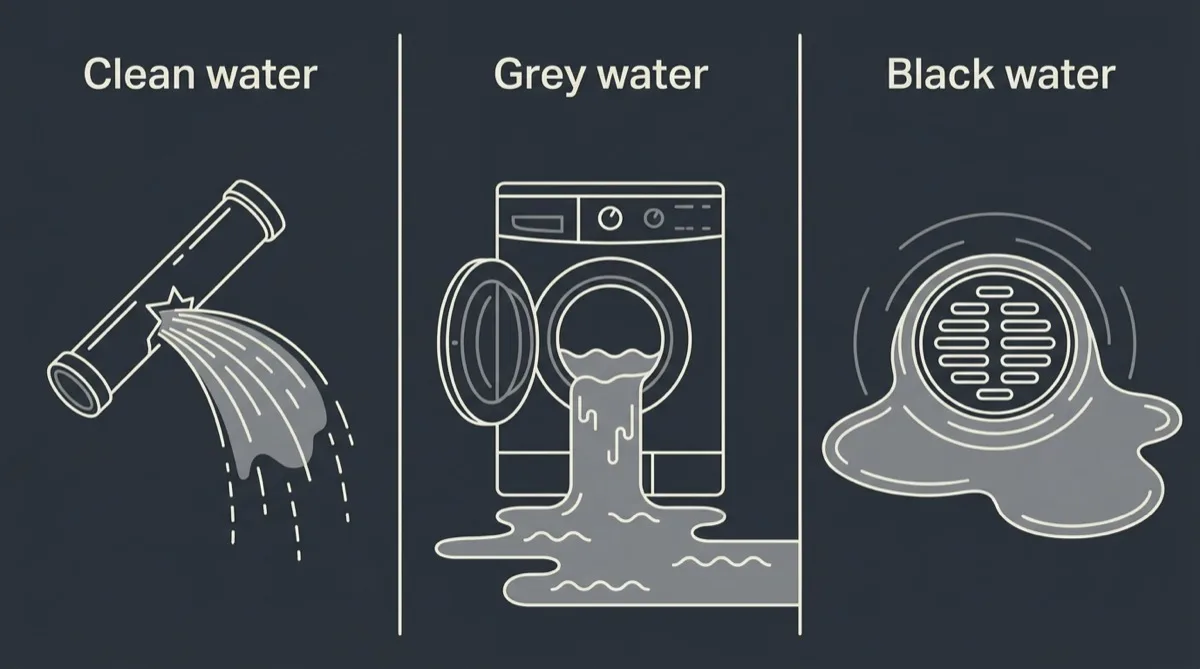
The categories come from the IICRC S500 standard and describe contamination, not volume. Category 1 is clean water from a supply line: a burst pipe, a fridge line, a dishwasher feed that let go while full of potable water. Category 2 is grey water, which has passed through an appliance or fixture and carries detergent, food waste or biological load. A washing machine overflow and a dishwasher discharge sit here, and the cleanup adds sanitization that a Category 1 job does not need. Category 3 is black water: sewage, a floor drain backup, or surface flooding that ran across a yard and a driveway before it reached the basement.
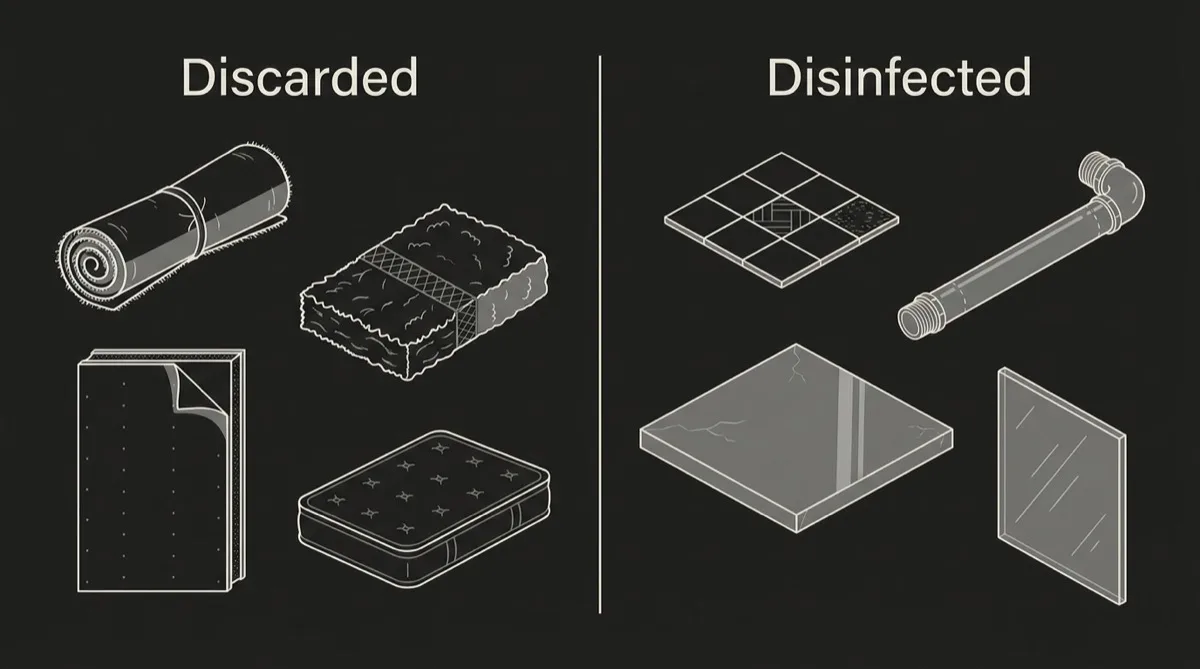
The reason the classification matters more than the volume is what it does to porous material. IICRC S500 classifies sewage as Category 3, and under that standard porous materials must be removed and discarded rather than dried in place. Drywall below the waterline, carpet, underpad, insulation, upholstered furniture and mattresses leave the house. Hard non-porous surfaces can be disinfected and kept. A Category 1 job with the same footprint dries most of that material where it stands, which is why one crew leaves with a truckload of debris and another leaves with a stack of air movers.
The three price bands in Toronto
The job-class ranges published by The Sewer and Drain in Toronto separate cleanly. Category 1 clean water runs $1,000 to $4,000, with the low end of that range coming from Desa Contracting. Category 2 grey water, including sanitization, runs $4,000 to $6,500. The Sewer and Drain publishes $6,000 to $12,000 or more for Category 3 black water, including full material removal and disinfection; the water damage restoration cost page widens that to $4,000 to $30,000 or more using Ultimate Mold Crew and Desa Contracting figures.
Per-square-foot rates show the same gap in a different unit. Desa Contracting's all-in Toronto rate for water damage cleanup is $3 to $12 per square foot across all categories, while DKI Canada publishes $7 to $8 per square foot specifically for Category 3 black water cleanup and extraction, and Ratehub.ca uses $7 to $14 per square foot for sewer backup damage assessment. Sewage work also gets tiered by contaminated area rather than by whole-house size: The Sewer and Drain prices a minor backup under 100 square feet at $2,500 to $4,000, with Ideal Response quoting from $1,500, a moderate one covering 100 to 500 square feet at $4,000 to $7,500, and a severe flood over 500 square feet in a finished basement at $7,500 to $12,000 or more for cleanup alone. Flood Assist's Toronto and GTA guide puts a total severe incident including tear-out and rebuild at $5,000 to $50,000.
Categories are not fixed at the moment of the flood
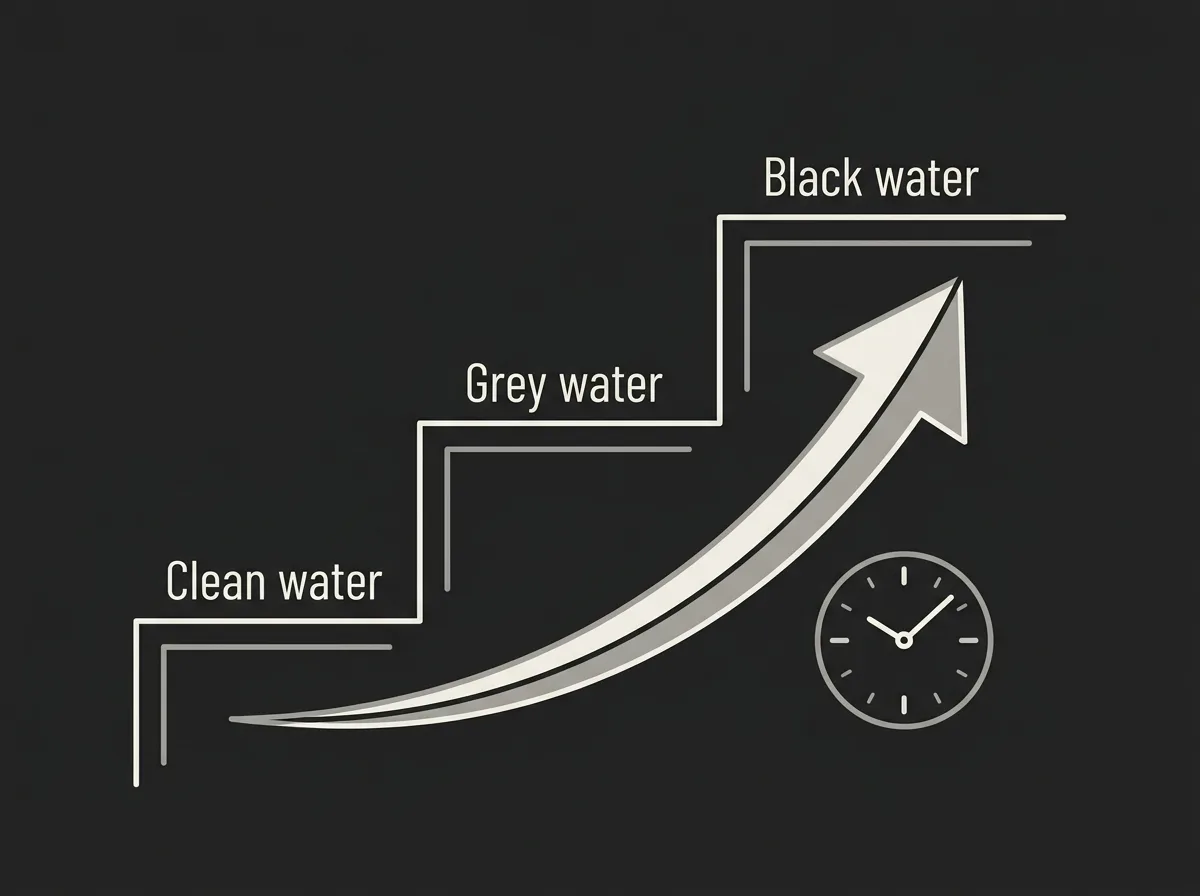
Clean water does not stay clean. Standing water picks up contamination from what it sits on and what it dissolves, and a Category 1 incident that goes unaddressed becomes a Category 2 or Category 3 job by the time crews arrive. That reclassification carries the whole price step with it, because the tear-out rule follows the category rather than the origin of the water.
Biological growth runs on the same clock. Mould can begin within 24 to 72 hours of a flood, and Ultimate Mold Crew in Toronto prices the remediation added by delayed drying at $1,500 to $6,000 or more. On the sewage side the penalty is larger: Flood Assist, citing Canada Mortgage and Housing Corporation data, puts mould remediation after a delayed sewage cleanup at $1,500 to $15,000 per incident. The Insurance Bureau of Canada states prompt mitigation can cut repair costs by up to 30 percent, and that insurers can deny or reduce claims for delayed action. The category a homeowner has on day three is partly a function of what happened on day one.
What leaves the house, and what that costs
On a Category 3 job the disposal volume is the visible difference. Contaminated drywall gets cut above the waterline, flooring and underpad come out whole, and anything absorbent that the water touched goes into a bin. Toronto's disposal rules for Category 3 contaminated materials add handling and tipping cost over ordinary renovation debris, which is one reason sewage quotes rise faster than the affected square footage does.
Disposal is normally bundled into a cleanup quote, and its price when unbundled is knowable. Bins Toronto's 2026 price guide puts a seven-day bin rental with roughly one tonne included at $275 to $650, and Junk Professionals in the GTA charges $250 to $700 per half-to-full truckload for flood-damaged belongings. The Insurance Bureau of Canada advises documenting all damage with photos or video before anything is disposed of, which matters most on the category where the most material leaves. Finish level compounds all of it: bare concrete and block need extraction and disinfection, while a finished basement adds demolition of the same material a Category 1 loss would have dried.
How the category maps onto coverage
The category also predicts which part of an Ontario policy is in play, because coverage follows the path the water took rather than how dirty it ended up. Water from an indoor plumbing failure, an appliance rupture or ice damming is the sudden and accidental loss that the Insurance Bureau of Canada describes standard Ontario policies as covering. That is the same event that produces most Category 1 losses.
The two categories that cost the most are the two that a base policy excludes. Water backing up through drains or a sump needs a sewer backup endorsement, priced at roughly $20 to $250 per year in Ontario by Mitch Insurance Brokers. Surface water from rain or snowmelt entering the home needs overland water coverage, which isure prices at roughly $10 to $30 per month in lower-risk areas. Both endorsements carry capped limits, commonly $10,000 to $30,000 for sewer backup per ThinkInsure, which sits below the top of The Sewer and Drain's Category 3 range. A homeowner who bought neither endorsement is paying the black-water price out of pocket, whatever the category on the estimate says.
Who in the index lists which category
The six categories on the site are not evenly staffed. Of the 294 companies in the index, 258 carry water damage restoration, 200 carry mould removal, 78 carry fire and smoke restoration, 59 carry mould inspection and testing, 37 carry basement flood cleanup and 30 carry sewage backup cleanup. Those last two hubs were merged into water damage restoration in August 2026 because every company under them was already listed there, so the companies appear on that page, ordered by the RestorationIndex Score. Black-water work is the narrowest category on the site, and 25 of those 30 companies also list mould removal, which tracks the way a delayed sewage job turns into a mould job.
Geography thins it further. The sewage listings spread across the GTA in ones and twos: three sit in Islington-City Centre West and three in Don Mills, with the rest one or two to an area. What the records do not contain is any credential. Ontario has no provincial licensing for mould or sewage remediation, IICRC certification such as WRT and ASD is voluntary, and the index stores no certification, licence status or insurance data for any of the 294 companies. That check belongs to the phone call, and 291 of the 294 records carry a phone number to make it with. Published ranges for the contaminated end of the work sit on the sewage cleanup cost guide.
Frequently asked questions
How do I tell which water category I have?
- By where the water came from. A burst supply line or an appliance feed is Category 1 clean water. A washing machine or dishwasher overflow is Category 2 grey water. Anything from a sewer, a floor drain backup or surface flooding from outside is Category 3 black water. Time changes the answer, since clean water left standing degrades into the higher classes.
Why does sewage cost so much more to clean up?
- The IICRC S500 standard classifies sewage as Category 3, which means porous materials must be removed and discarded rather than dried in place. That converts a drying job into a demolition and disposal job. Toronto firms price Category 3 work from $4,000 per Ultimate Mold Crew to $30,000 or more per Desa Contracting, against The Sewer and Drain's $2,500 to $4,000 for a clean-water job.
What does black water cost per square foot in Toronto?
- DKI Canada publishes $7 to $8 per square foot for Category 3 black water cleanup and extraction, and Ratehub.ca uses $7 to $14 per square foot for sewer backup damage assessment. For comparison, Desa Contracting's all-in Toronto rate for water damage cleanup across all categories is $3 to $12 per square foot.
Does a finished basement change the category?
- No, but it changes what the category costs. The Sewer and Drain tiers sewage cleanup by contaminated area: $2,500 to $4,000 under 100 square feet with Ideal Response quoting from $1,500, $4,000 to $7,500 for 100 to 500 square feet, and $7,500 to $12,000 or more for a severe flood in a finished basement. Bare concrete needs extraction and disinfection with nothing to tear out.
How many companies in the index list sewage work?
- Thirty of the 294 companies carry the sewage backup cleanup category, the smallest of the six categories on the site. Twenty-five of those 30 also list mould removal. The index records no certification data, so IICRC credentials have to be verified with the company rather than looked up here.
Figures on this page, and where each one comes from
Category 1 clean water runs $1,000 to $4,000, Category 2 grey water $4,000 to $6,500, and Category 3 black water $6,000 to $12,000 or more.
The Sewer and Drain (Toronto) with the Category 1 low end from Desa Contracting, via this site's water damage cost research
Category 3 black water cleanup and extraction runs $7 to $8 per square foot, and sewer backup damage assessment $7 to $14 per square foot.
DKI Canada and Ratehub.ca, via this site's sewage cleanup cost research
A seven-day bin rental with roughly one tonne included costs $275 to $650, and junk haul-away of flood-damaged belongings $250 to $700 per half-to-full truckload.
Bins Toronto 2026 price guide and Junk Professionals, via this site's sewage cleanup cost research
A sewer backup endorsement runs roughly $20 to $250 a year in Ontario and overland water coverage roughly $10 to $30 a month in lower-risk areas, with sewer backup limits commonly capped at $10,000 to $30,000.
Mitch Insurance Brokers, isure and ThinkInsure, via this site's insurance research
Keep reading
Check a company before you call it
Every profile on RestorationIndex carries the hours the firm posts, its public Google review record and a quote request.
Open the directory