Skip to content
RestorationIndex

How Much Does Water Damage Restoration Cost in Toronto in 2026?

Water damage cleanup runs about $4 to $12 per square foot all-in in Toronto, according to Desa Contracting. Priced as whole jobs instead, The Sewer and Drain averages $2,500 to $4,000 for clean water and $6,000 to $12,000 and up for sewage. Emergency extraction adds $500 to $3,000, and structural drying with industrial dehumidifiers runs $800 to $4,000.

Page last updated: By The RestorationIndex Desk
What are the headline prices?

  • $150$500+ per emergency call, added to the job costEmergency after-hours call-out fee (nights and weekends) (Desa Contracting (Toronto))
  • $4$12 per sq ftWater damage cleanup, all-in rate (Desa Contracting (Toronto))
  • $500$3,000 per jobEmergency water extraction and pump-out (standing water removal) (Desa Contracting (Toronto))
  • $800$4,000 per jobStructural drying and dehumidification (industrial fans and dehumidifiers) (Desa Contracting (Toronto))
  • $2,500$4,000 per jobCategory 1: clean water job (burst supply pipe, appliance line) (The Sewer and Drain (Toronto))
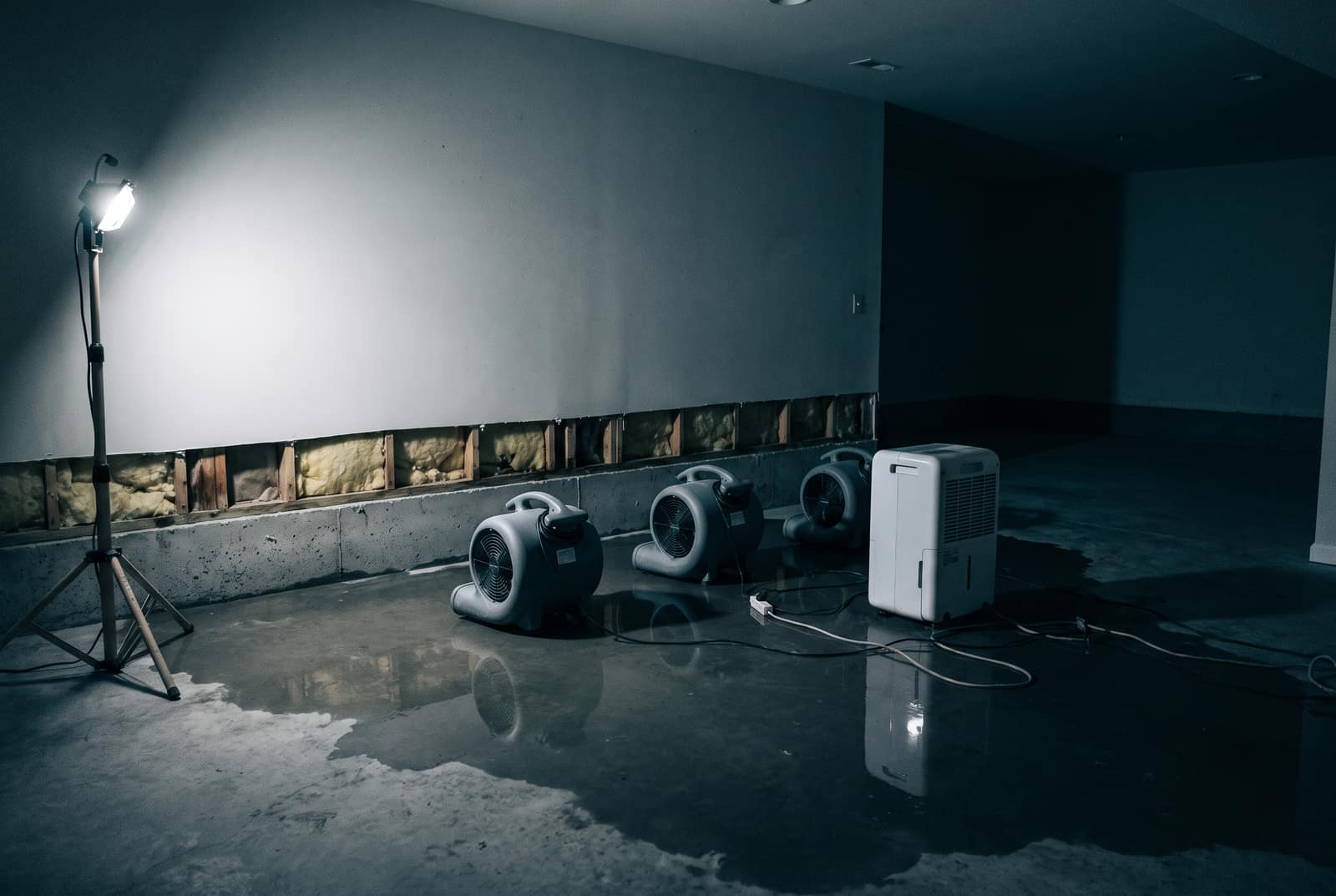
An empty residential basement at night, lit by one work light on a tripod. Standing water has been pulled back to a wet sheen on the concrete, the drywall is cut away in a straight line a foot above the floor with the studs and insulation showing, and three air movers and a dehumidifier are running against the wall.
Illustration of a water damage restoration scene, generated for this guide. It is not a photograph of a real job, no company listed on this site appears in it, and it carries no figure. The photographs further down the page are real and are credited to the companies that published them.

Can I price my own water damage restoration job?

Yes, to within the range the table below publishes. Enter the size of what you are dealing with and these work it out against the same source-cited rates, so the number you get is the published market applied to your job rather than a national average.

What does water damage restoration cost by job type and stage?

This range rests on 6 independent published sources, across 13 price rows. Where two of them disagree, each row carries the figure of the source it names rather than a band stretched across both, and a figure that was not in its named source was removed.

Read the note under each figure before you compare it with a quote. All 13 rows below carry the caveat their own source attached to the number: what the price does and does not cover, where it is a floor rather than a band, and who has to already be on site for it to hold. That caveat is the usual reason two honest water damage restoration bids differ.

Water Damage Restoration prices in Greater Toronto Area, re-checked August 2026 against 6 independent Canadian sources. Canadian dollars, a named source on every row, 13% HST on top unless the row says otherwise. 13 of 13 rows also print the caveat their source attached to the figure.

Emergency after-hours call-out fee (nights and weekends)

Typical range
$150$500+
Unit
per emergency call, added to the job cost
Source
Desa Contracting (Toronto)

What the source attaches to it

Open-ended at the top: the source writes $500+, not $500. Holiday or overnight response is priced separately by the same firm at $250 to $1,000.

Water damage cleanup, all-in rate

Typical range
$4$12
Unit
per sq ft
Source
Desa Contracting (Toronto)

What the source attaches to it

Depends on the severity and the category of the water; a Category 3 job sits at the top of the band.

Emergency water extraction and pump-out (standing water removal)

Typical range
$500$3,000
Unit
per job
Source
Desa Contracting (Toronto)

What the source attaches to it

Extraction only. The same firm's line item for material removal is priced separately at the same $500 to $3,000.

Structural drying and dehumidification (industrial fans and dehumidifiers)

Typical range
$800$4,000
Unit
per job
Source
Desa Contracting (Toronto)

What the source attaches to it

Cost scales with equipment-days on site rather than with a flat visit fee.

Category 1: clean water job (burst supply pipe, appliance line)

Typical range
$2,500$4,000
Unit
per job
Source
The Sewer and Drain (Toronto)

What the source attaches to it

The source states this as an average for the category rather than a floor and ceiling.

Category 2: grey water job (washing machine or dishwasher overflow), including sanitization

Typical range
$4,000$6,500
Unit
per job
Source
The Sewer and Drain (Toronto)

What the source attaches to it

The band includes the sanitization requirements that separate Category 2 from Category 1.

Category 3: black water and sewage backup job (full material removal and disinfection)

Typical range
$6,000$12,000+
Unit
per job
Source
The Sewer and Drain (Toronto)

What the source attaches to it

Open-ended at the top, and stated as an average: complete material removal and extensive reconstruction are what push it there.

Independent moisture and air-quality inspection with thermal imaging

Typical range
$224$224
Unit
per inspection
Source
Inspectionly (Ontario)

What the source attaches to it

A flat published fee, not a range. Includes thermal imaging, moisture meters and a same-day report from an RHI-certified inspector.

Rebuild and reconstruction after drying (drywall, flooring, baseboards, insulation)

Typical range
$1,000$20,000+
Unit
per job
Source
Desa Contracting (Toronto)

What the source attaches to it

Open-ended at the top. This is the rebuild only and sits on top of the drying and extraction line items above.

Drywall removal and replacement after water damage

Typical range
$300$1,200
Unit
per job
Source
Desa Contracting (Toronto)

What the source attaches to it

Removal and replacement of the board itself; painting and trim are separate line items on the same list.

Mold remediation if drying was delayed past 24 to 48 hours

Typical range
$1,500$6,000+
Unit
per job
Source
Ultimate Mold Crew (Toronto)

What the source attaches to it

Open-ended at the top; depends on the affected area, material type and containment needs.

Sewer backup insurance endorsement (prevention-side cost)

Typical range
$20$250
Unit
per year
Source
Mitch Insurance Brokers (Ontario)

What the source attaches to it

Where you land in the band depends on your risk factors. It is an add-on to a home policy, not standard coverage.

Overland water insurance endorsement

Typical range
$10$30
Unit
per month
Source
isure Insurance (Ontario)

What the source attaches to it

Lower-risk areas only, and stated as an average. High-risk homes pay more or may not qualify.

Which water damage restoration figures are firm, and which are a wide range?

The same flood reaches this page priced three different ways: by the call-out, by the square foot, and by the category of water that came in. They are drawn apart below, because a rate and a job total are not the same kind of number.

10 of the 13 priced rows on this page are drawn to scale below, grouped so that only rows priced on the same basis ever share an axis. A bar starts at the low figure its source published and ends at the high one, so its length is how much room the scope leaves. That is the part of a quote there is anything to argue about.

Quoted as one figure, not as a rate

  • Emergency after-hours call-out fee (nights and weekends)$150$500+

    per emergency call, added to the job cost

  • Independent moisture and air-quality inspection with thermal imaging$224$224

    per inspection. One published figure, not a range.

  • Drywall removal and replacement after water damage$300$1,200

    per job

  • Emergency water extraction and pump-out (standing water removal)$500$3,000

    per job

  • Structural drying and dehumidification (industrial fans and dehumidifiers)$800$4,000

    per job

  • Rebuild and reconstruction after drying (drywall, flooring, baseboards, insulation)$1,000$20,000+

    per job

  • Mold remediation if drying was delayed past 24 to 48 hours$1,500$6,000+

    per job

  • Category 1: clean water job (burst supply pipe, appliance line)$2,500$4,000

    per job

  • Category 2: grey water job (washing machine or dishwasher overflow), including sanitization$4,000$6,500

    per job

  • Category 3: black water and sewage backup job (full material removal and disinfection)$6,000$12,000+

    per job

Log scale: every step along the axis multiplies, it does not add.

4 bars fade out at the right instead of stopping. That is a range whose source published a floor for the top and no ceiling, written here the way the source wrote it, with a trailing plus sign. The bar is drawn only as far as the figure that was actually published. How much further it runs is the question to put to the contractor before signing.

Rows not drawn to scale

  • $4$12 per sq ft. Water damage cleanup, all-in rate. The only row on this page quoted by floor area, and one bar on its own is not a comparison.
  • $20$250 per year. Sewer backup insurance endorsement (prevention-side cost). The only row on this page quoted as a yearly premium, and one bar on its own is not a comparison.
  • $10$30 per month. Overland water insurance endorsement. The only row on this page quoted as a monthly premium, and one bar on its own is not a comparison.

What decides how much of the basement has to come out?

The category of the water, before anything else. It is not a severity label, it is a method: it decides whether the material that got wet is dried where it stands or cut out and thrown away, and that single decision is most of the difference between the three job prices in the table above.

  1. Category 1, clean water

    Water from a supply line or a tank, carrying nothing.

    • A burst supply pipe or an appliance line
    • Dried in place, so the material stays
    • Extraction, then air movers and dehumidifiers against the structure itself
  2. Category 2, grey water

    Water carrying detergent or food out of an appliance.

    • A washing machine or a dishwasher overflow
    • Sanitization on top of the drying
    • Still dried rather than removed, where it is caught early
  3. Category 3, black water

    Sewage, a backed-up drain, or the ground outside.

    • Porous material is cut out and thrown away, not dried
    • Full material removal and disinfection
    • Roughly doubles to triples the job cost against clean water

What drives the price?

Scope, contamination and access, in that order. Below is what moves water damage restoration pricing most in Toronto, each one drawn from a source named in the table above, so you can read a quote and see where the money goes.

  • Water category: clean (Cat 1) vs grey (Cat 2) vs black/sewage (Cat 3): contaminated water forces removal and disposal of porous materials instead of drying them, roughly doubling-to-tripling job cost
  • Square footage and how many rooms and floors the water reached ($4 to $12 per sq ft in Toronto, per Desa Contracting)
  • Time elapsed before mitigation: mold can start in 24–48 hours and adds $1,500–$6,000+ in remediation
  • Materials affected: hardwood ($2,000–$8,000 to replace) vs laminate ($800–$2,500) vs bare concrete
  • Timing of the call: Desa Contracting adds $150 to $500+ for an after-hours emergency and $250 to $1,000 for holiday or overnight response
  • Number of drying-equipment days on site (equipment billed per day; typical dry-out is 24–72 hours)
  • Scope of rebuild after drying: drywall, baseboards, insulation, cabinetry ($1,000–$5,000 for cabinet work alone)
  • Whether the job is insurance-billed (documented to claim standards) or cash
  • Accessibility and finish level: a fully finished basement costs far more than an unfinished one

What's specific to Ontario and Toronto?

Three things: 13% HST on every quote, a City of Toronto rebate on prevention work, and no provincial licence for this trade at all. National price guides miss all three.

  • Insurance defaults (Insurance Bureau of Canada): standard Ontario home policies cover sudden, accidental water damage (burst pipes, appliance ruptures, ice damming) but NOT sewer backup or overland flooding: both are optional endorsements. Overland water coverage is risk-rated and commonly bundled with sewer backup; some highest-risk homes cannot buy it at all.
  • Endorsement costs: sewer backup adds roughly $20–$250/year (Mitch Insurance); overland water runs $10–$30/month in low-to-moderate-risk areas (isure). Water endorsements often carry higher deductibles ($1,000–$2,500) and capped payout limits, commonly $10,000–$30,000 for sewer backup (ThinkInsure).
  • Toronto Basement Flooding Protection Subsidy (City of Toronto): as of May 1, 2026 the City offers up to $6,650 in subsidies per property. It pays 80% of the invoiced cost up to $1,600 per backwater valve (maximum two), $2,250 for a sump pump, $500 for a one-time home plumbing assessment, $300 for a sump-pump battery backup and $400 for severing and capping weeping tiles. Those per-device maximums apply to work completed on or after November 12, 2025; earlier work is capped lower ($1,250 per backwater valve, $1,750 for a sump pump). Apply within two years of the installation.
  • HST: restoration and rebuild services are subject to 13% HST in Ontario; contractor pricing pages and quotes are typically pre-HST, so add 13% when budgeting. Insurance settlements for covered repairs include the HST on those repairs.
  • Health Canada mold guidance: Health Canada treats any indoor mould as a potential health risk and sets no 'safe' exposure limit. Its residential guidance is that small patches (under about 1 square metre) can be cleaned by the occupant with proper precautions, while larger or recurring growth: typical after an unmitigated flood: warrants professional remediation and fixing the moisture source.
  • Ontario has NO provincial licensing for mold remediation or water damage restoration: anyone can advertise the service. The practical quality screen is IICRC certification (WRT: Water Damage Restoration Technician, ASD: Applied Structural Drying) and adherence to the IICRC S500 standard; Toronto firms like The Sewer and Drain, Ultimate Mold Crew and Canada's Restoration Services advertise IICRC-certified technicians.
  • Some Ontario insurers pay up to $1,500 toward installing backwater valves and sump pumps after a water claim to prevent recurrence (Mitch Insurance): ask your adjuster before paying for prevention out of pocket, and stack it with the City subsidy where eligible.

How can I pay less?

Act inside the first 24 to 48 hours, get more than one quote, and claim every rebate you qualify for. Those three do more than anything else on this list. Each lever below is tied to a real number in the table above.

  • Act within the first 24–48 hours: stopping the source and starting extraction immediately is the single biggest cost lever, because it avoids $1,500–$6,000+ in mold remediation and wood rot.
  • Claim the City of Toronto Basement Flooding Protection Subsidy for prevention: up to $6,650 per property, at 80% of invoiced cost, toward backwater valves, a sump pump, battery backup and a plumbing assessment.
  • For a small clean-water (Cat 1) leak, price an equipment rental against a professional dry-out before you book one: Desa Contracting prices professional industrial drying at $800 to $4,000. Never DIY grey or black water.
  • Get 2–3 quotes: free on-site estimates are standard across GTA firms, and published ranges for the same job class vary by thousands of dollars.
  • Do the deductible math before filing a claim: if quotes are near your $1,000–$2,500 deductible, paying cash keeps a claim off your record and avoids premium hikes.
  • Ask your insurer about prevention rebates: some Ontario insurers contribute up to $1,500 toward a backwater valve or sump pump after a claim.
  • Confirm the quote includes debris disposal, antimicrobial treatment and HST: the 13% HST plus disposal fees are common surprise line items on 'low' quotes.

How did we research these numbers?

By opening every source and finding the sentence that carries the figure. Every row on this page records the source it came from, the literal sentence in that source, and where that sentence sits in a cached copy of the page; a build gate reopens the cache and re-finds it. A figure whose source could not be read was removed rather than republished, and no number was adjusted to make an attribution true.

  • Every figure in the table above was re-checked in August 2026 against the cached text of the page it is attributed to. Where a range could not be found in its named source it was replaced by that source own published figure or the row was removed. No number was adjusted to make an attribution true.
  • Two rows that used to be widened bands across disagreeing sources are now single-source figures. Category 1 clean-water jobs were published here as $1,000-$4,000 by mixing two firms; The Sewer and Drain, the source named on the row, states $2,500-$4,000. Category 3 was published as $4,000-$30,000+; the same source states $6,000-$12,000+.
  • Toronto sources still disagree about Category 3, and the disagreement is real rather than something to average away: The Sewer and Drain states $6,000-$12,000+, Ultimate Mold Crew $4,000 to $15,000+ for sewage backup cleanup, and Desa Contracting $5,000 to $30,000+. The table carries the figure of the source it names.
  • One row was deleted outright. A DIY LGR dehumidifier rental rate came from DryingEquipment.ca, whose pages now answer every non-browser request with a SiteGround captcha wall, so the figure cannot be checked and no longer appears.
  • Per-square-foot figures circulated on US guides (HomeAdvisor and Angi, in USD) were excluded rather than converted. The only per-square-foot rate on this page is Desa Contracting Canadian $4 to $12.
  • Most large GTA restoration firms publish no prices at all: the norm is a free on-site estimate plus direct insurance billing, so published ranges skew toward mid-size firms that use a pricing page for search traffic. Treat them as market anchors, not quotes.
  • All published contractor ranges are pre-tax; add 13% HST. Drying normally runs 24 to 72 hours of equipment time, and total job cost scales with equipment-days on site.

Sources

Who can do the work?

The photographs below belong to the water damage restoration companies this site's published score puts at the top: their own vans, premises and jobs, as published on their own Google listings and read in July 2026. Nothing here was shot for this page.

  • Orange containment sheeting spread across a hardwood kitchen floor, with a broom, a spirit level and a spray bottle laid out beside it
  • A worker in a white protective suit and a full-face respirator crouching between roof trusses in an attic, vacuuming the boards with a canister unit, lit by one clamped work light
  • Two workers in white protective suits kneeling in an attic, bagging loose blown-in insulation from between the trusses under a single work light
  • Two dozen blue air movers and extractors laid out on a driveway beside an open van and a disposal bin, staged before a job
  • A white Sprinter van and two enclosed trailers parked on wet asphalt outside a concrete-block depot under a grey sky
  • A hand holding a thermal imaging camera up to a bedroom wall, the screen showing a cold blue patch spreading across an otherwise warm surface

6 of the photographs these companies publish themselves, in the order this site's published score puts them: Ultimate Mold Crew - Mold Removal Toronto, Canada's Restoration Services, Canada's Restoration Services, 5 Star Cleaning - Water Remediation, Toronto Hoarding and Disaster Solutions, Restoration Professionals.

2 higher-placed companies were passed over here because the lead photograph is marketing creative, a before-and-after composite or a posed booth shot rather than a picture of a job. They are still in the list below and on the full water damage restoration page.

RestorationIndex tracks 258 water damage restoration companies across the Greater Toronto Area, rated 4.75★ on average. The three below rank highest on our published score, based on RestorationIndex's analysis of 258 GTA businesses, July 2026.

See all 258 water damage restoration companies on RestorationIndex

What do the terms in a water damage restoration quote mean?

These are the 6 words the quotes above are written in, defined from what this page's own sources say about them. Knowing them is most of the difference between comparing two bids and guessing between them, and each one has its own link so a definition can be pointed at on its own.

Water category
The IICRC's grading of how contaminated the water is. Category 1 is clean water from a supply line or tank, Category 2 is grey water carrying detergent or food from an appliance, and Category 3 is black water from sewage, a backed-up drain or the ground outside. The category decides the method: clean water is dried in place, black water means porous material is cut out and thrown away.
Mitigation
The emergency phase: stopping the source, extracting standing water and drying the structure. It ends at bare studs and a clean subfloor with a moisture reading somebody signs, and it is a separate contract from the rebuild even when one company sells both.
Structural drying
Running industrial air movers and low-grain refrigerant dehumidifiers against the building itself, monitored daily with a moisture meter, until the material behind the surface reads dry. It is billed by equipment-days on site rather than as a flat visit fee.
IICRC S500
The Institute of Inspection, Cleaning and Restoration Certification's standard for water damage work, and the document a Toronto scope is implicitly written against. Ontario has no provincial licence for this trade at all, so the certifications built on that standard, WRT for water damage restoration and ASD for applied structural drying, are the practical screen a homeowner has instead of one.
Payout cap
The ceiling an Ontario water endorsement puts on what it will pay, set well below the limit on the rest of the policy and usually paired with a higher deductible than the policy's own. It is the figure that decides whether an endorsement covers a finished basement or only contributes to one.
Equipment-day
The unit drying is billed in. The air movers and low-grain dehumidifiers left running in the house are charged by machine-day rather than as a flat visit fee, so two quotes for the same room can differ mostly on how long each firm expects the material behind the surface to take to read dry.

What should I ask a water damage restoration contractor before signing?

  • Are your technicians IICRC certified for water damage restoration (WRT)?
  • Have you billed directly to home insurers before, and will you document the loss for my claim? Price your own job with the water damage restoration cost
  • What water category are you treating this as (1, 2 or 3), and how does that change the work?
  • How will you monitor moisture and prove the structure is fully dry before any rebuild?
  • Do you handle the rebuild too, or only the mitigation and drying?

What else do people ask about water damage restoration costs?

How much does it cost to clean up a flooded basement in Toronto?

Toronto sources put a residential water damage job between $2,500 and $7,500 (The Sewer and Drain). A clean-water Category 1 leak averages $2,500 to $4,000 and a sewage-contaminated Category 3 job averages $6,000 to $12,000 or more, because contaminated material has to be removed rather than dried. Per-square-foot pricing in Toronto runs $4 to $12 depending on contamination level and how long the water sat (Desa Contracting).

Do restoration companies charge a fee just to come out?

Most GTA firms, including GTA Restoration and Canada's Restoration Services, offer free on-site estimates. The premium shows up after hours: Toronto contractors add roughly $150–$500 for night and weekend emergencies and $250–$1,000 for holiday or overnight response, on top of the job cost. Ask whether any assessment fee is waived if you proceed with the work.

Will my home insurance cover water damage in Ontario?

Standard policies cover sudden accidents like burst pipes, but sewer backup and overland flooding need optional endorsements: roughly $20–$250 per year for sewer backup and $10–$30 per month for overland water in lower-risk areas. Expect a deductible of $1,000–$2,500 on water losses, and note endorsements often carry capped limits of $10,000–$30,000.

How much does sewage backup (black water) cleanup cost in Toronto?

The Sewer and Drain puts Category 3 black-water contamination at $6,000 to $12,000 or more in Toronto, because contaminated drywall, flooring and insulation must be removed rather than dried. Other GTA firms publish wider bands for the same work: Ultimate Mold Crew $4,000 to $15,000+, Desa Contracting $5,000 to $30,000+. Where they disagree, this page carries the figure of the source it names on each row rather than averaging them.

Can I rent drying equipment and dry it out myself?

For a small clean-water (Category 1) leak, yes, provided you stop the source, move air across every wet surface and verify dryness with a moisture meter rather than by touch. This page no longer quotes a Toronto rental rate: the rental firm it used to cite now blocks every non-browser request, so the figure could not be re-checked. For comparison, Desa Contracting prices professional industrial drying at $800 to $4,000. Never DIY grey or black water.

How much is a professional moisture inspection?

Many GTA restoration companies inspect free as part of quoting. For an independent assessment, Ontario firm Inspectionly charges a flat $224 for a moisture and air-quality inspection with thermal imaging, moisture meters and a same-day report. An independent report is worth paying for when you suspect hidden moisture or are disputing an insurer repair scope.

Should I file an insurance claim for minor water damage?

Run the math against your deductible first. If cleanup quotes come in near your $1,000–$2,500 deductible, paying out of pocket keeps a claim off your record and avoids potential premium increases. For larger losses: the average urban basement flood causes about $42,000 in damage: claiming clearly makes sense. Photograph everything before cleanup either way.

Does Toronto help pay for basement flood prevention?

Yes. The City's Basement Flooding Protection Subsidy covers 80% of invoiced costs up to $6,650 per property for work completed on or after November 12, 2025: nearly double the old $3,400 cap. That includes up to $1,600 per backwater valve, $2,250 for a sump pump, $500 for a plumbing assessment, $300 for battery backup and $400 for pipe severance.

What else should I read before booking water damage restoration?

Who handles water damage restoration in the GTA?

Every company on the list below its own page shows its hours, its area and a quote request.

See water damage restoration