Skip to content
RestorationIndex

How Much Does Sewage Backup Cleanup Cost in Toronto in 2026?

Category 3 (black water) sewage cleanup runs about $7 to $8 per square foot in Toronto, the dearest of the three water categories, according to DKI Canada. A minor backup around 100 square feet averages $2,500 to $4,000 and a moderate one $4,000 to $7,500 per The Sewer and Drain, and a severe incident including tear-out and rebuild reaches $5,000 to $50,000 per Flood Assist.

Page last updated: By The RestorationIndex Desk
What are the headline prices?

  • $7$8 per sq ftCategory 3 (black water) cleanup and extraction (DKI Canada)
  • $2,500$4,000 per jobMinor sewage backup cleanup (about 100 sq ft) (The Sewer and Drain (Toronto))
  • $4,000$7,500 per jobModerate sewage backup cleanup (100 to 500 sq ft) (The Sewer and Drain (Toronto))
  • $7,500$12,000+ per job, cleanup onlySevere sewage flood cleanup (over 500 sq ft) (The Sewer and Drain (Toronto))
  • $5,000$50,000 per incidentTotal severe incident including tear-out and rebuild (Flood Assist (Toronto and GTA))
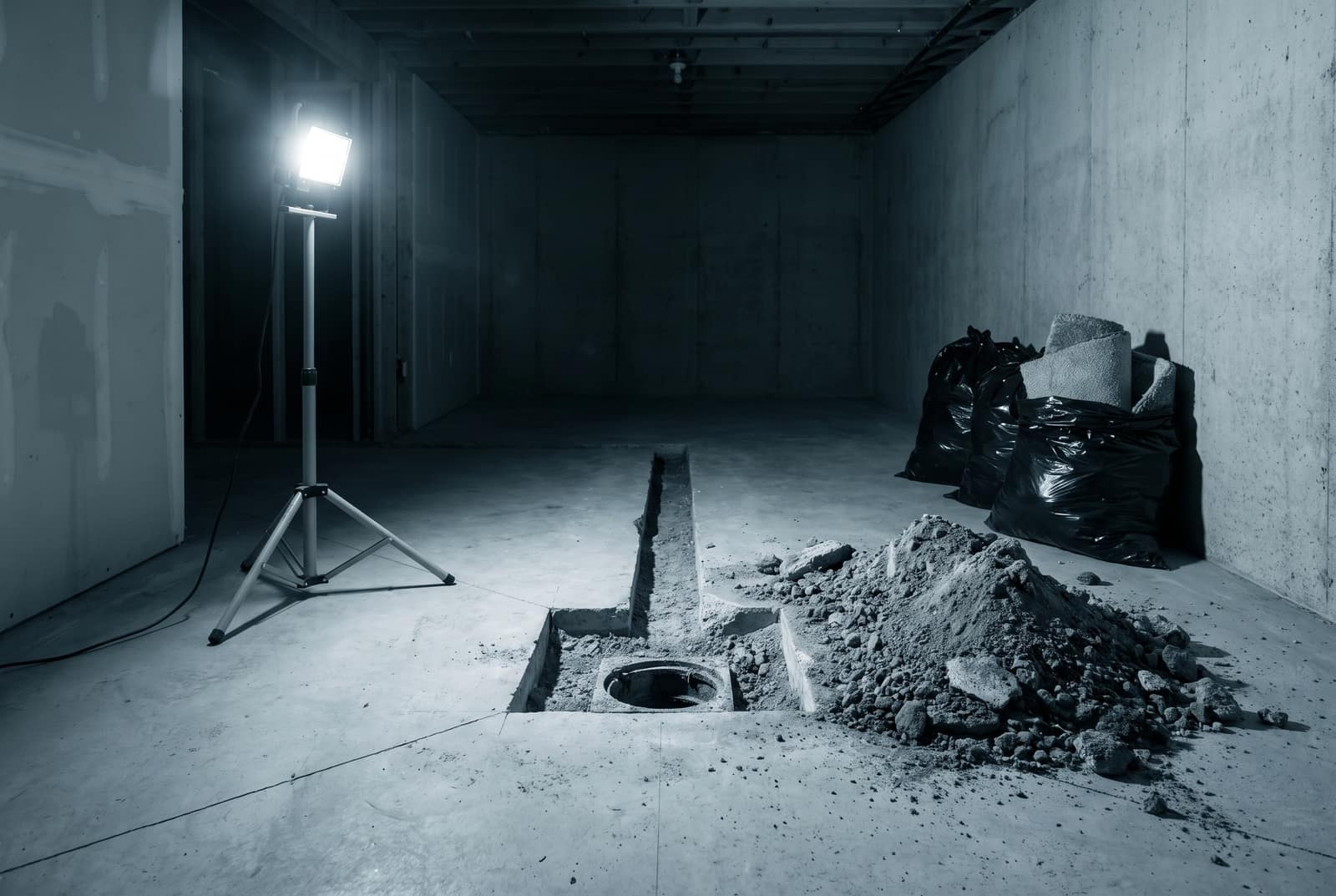
An empty stripped basement at night, lit by one work light on a tripod. A saw-cut trench has been opened across the concrete slab to an exposed floor drain, spoil is heaped beside it, and bagged carpet and underpad are stacked against the far wall.
Illustration of a sewage backup cleanup scene, generated for this guide. It is not a photograph of a real job, no company listed on this site appears in it, and it carries no figure. The photographs further down the page are real and are credited to the companies that published them.

Can I price my own sewage backup cleanup job?

Yes, to within the range the table below publishes. Enter the size of what you are dealing with and these work it out against the same source-cited rates, so the number you get is the published market applied to your job rather than a national average.

What does sewage backup cleanup cost by severity?

This range rests on 9 independent published sources, across 14 price rows. Where two of them disagree, each row carries the figure of the source it names rather than a band stretched across both, and a figure that was not in its named source was removed.

Read the note under each figure before you compare it with a quote. All 14 rows below carry the caveat their own source attached to the number: what the price does and does not cover, where it is a floor rather than a band, and who has to already be on site for it to hold. That caveat is the usual reason two honest sewage backup cleanup bids differ.

Sewage Backup Cleanup prices in Greater Toronto Area, re-checked August 2026 against 9 independent Canadian sources. Canadian dollars, a named source on every row, 13% HST on top unless the row says otherwise. 14 of 14 rows also print the caveat their source attached to the figure.

Category 3 (black water) cleanup and extraction

Typical range
$7$8
Unit
per sq ft
Source
DKI Canada

What the source attaches to it

The highest per-square-foot tier of the three water categories, because the cleanup is hazardous. The same source puts the worst spread class (Class 4) at $20,000 to $100,000 for extreme cases.

Minor sewage backup cleanup (about 100 sq ft)

Typical range
$2,500$4,000
Unit
per job
Source
The Sewer and Drain (Toronto)

What the source attaches to it

Stated as an average for a minor basement backup at that size, not a floor and ceiling.

Moderate sewage backup cleanup (100 to 500 sq ft)

Typical range
$4,000$7,500
Unit
per job
Source
The Sewer and Drain (Toronto)

What the source attaches to it

Cleanup across multiple rooms. Rebuild of anything torn out is priced separately.

Severe sewage flood cleanup (over 500 sq ft)

Typical range
$7,500$12,000+
Unit
per job, cleanup only
Source
The Sewer and Drain (Toronto)

What the source attaches to it

Open-ended at the top, and cleanup only: it does not include the rebuild.

Total severe incident including tear-out and rebuild

Typical range
$5,000$50,000
Unit
per incident
Source
Flood Assist (Toronto and GTA)

What the source attaches to it

Varies with the extent of the damage. Personal items, electronics and HVAC systems are often irreparable, which is what carries the top of the band.

Structural disinfection and deodorizing (line item)

Typical range
$200$1,000
Unit
per job
Source
Desa Contracting (Toronto)

What the source attaches to it

A separate line item from extraction and drying. The same firm prices mold prevention treatment separately at $200 to $800.

Contaminated contents disposal: bin rental

Typical range
$275$650
Unit
per bin
Source
Bins Toronto (2026 price guide)

What the source attaches to it

Price is set by bin size: $275 buys a compact 4-yard bin and $650 a 30-yard container. Overweight loads are billed on top.

Sewer line snaking to clear the blockage

Typical range
$250$600
Unit
per visit
Source
Anta Plumbing (Toronto)

What the source attaches to it

The source says complex cases go higher than $600. Snaking clears the blockage; it does not repair a collapsed or root-invaded line.

Backwater valve installation, interior

Typical range
$2,000$3,500+
Unit
per installation, before rebate
Source
Canada Waterproofers (Toronto and GTA)

What the source attaches to it

Open-ended at the top, and before the City rebate. The City plumbing permit is a separate $214.79.

Backwater valve installation, exterior

Typical range
$2,700$4,500+
Unit
per installation, before rebate
Source
Canada Waterproofers (Toronto and GTA)

What the source attaches to it

Open-ended at the top, and before the City rebate. Exterior work needs excavation, which is why it is priced above the interior job.

City of Toronto plumbing permit for a backwater valve

Typical range
$214.79$214.79
Unit
flat fee
Source
Canada Waterproofers (Toronto and GTA)

What the source attaches to it

A flat 2026 fee, not a range. The permit is mandatory and the City subsidy maximums are stated as including permit costs.

City of Toronto backwater valve subsidy

Typical range
$1,600$1,600
Unit
per device, maximum two devices
Source
City of Toronto

What the source attaches to it

A ceiling, not a payment: the City pays 80% of the invoiced cost up to $1,600 per device, for a maximum of two devices, and only for work completed on or after November 12, 2025. Work completed before that date is capped at $1,250 for one device. You must be the registered owner and apply within two years of the installation.

Sewer backup insurance endorsement

Typical range
$150$300
Unit
per year
Source
Ratehub.ca

What the source attaches to it

Depends on the provider and the age and location of the house. In an area with a high frequency of claims the same source says the yearly cost can be as high as $700.

Mold remediation add-on if cleanup is delayed

Typical range
$1,500$15,000
Unit
per incident
Source
Flood Assist, citing CMHC

What the source attaches to it

Only applies if cleanup is delayed: the same source says mold growth can begin within 24 hours in Toronto's humid climate.

Which sewage backup cleanup figures are firm, and which are a wide range?

Sewage work splits into the cleanup itself and the plumbing that stops it happening again. Drawn out below with the unit printed under every bar, it is clear which part of a bid is which.

11 of the 14 priced rows on this page are drawn to scale below, grouped so that only rows priced on the same basis ever share an axis. A bar starts at the low figure its source published and ends at the high one, so its length is how much room the scope leaves. That is the part of a quote there is anything to argue about.

Quoted as one figure, not as a rate

  • Structural disinfection and deodorizing (line item)$200$1,000

    per job

  • City of Toronto plumbing permit for a backwater valve$214.79$214.79

    flat fee. One published figure, not a range.

  • Sewer line snaking to clear the blockage$250$600

    per visit

  • Contaminated contents disposal: bin rental$275$650

    per bin

  • Mold remediation add-on if cleanup is delayed$1,500$15,000

    per incident

  • Backwater valve installation, interior$2,000$3,500+

    per installation, before rebate

  • Minor sewage backup cleanup (about 100 sq ft)$2,500$4,000

    per job

  • Backwater valve installation, exterior$2,700$4,500+

    per installation, before rebate

  • Moderate sewage backup cleanup (100 to 500 sq ft)$4,000$7,500

    per job

  • Total severe incident including tear-out and rebuild$5,000$50,000

    per incident

  • Severe sewage flood cleanup (over 500 sq ft)$7,500$12,000+

    per job, cleanup only

Log scale: every step along the axis multiplies, it does not add.

3 bars fade out at the right instead of stopping. That is a range whose source published a floor for the top and no ceiling, written here the way the source wrote it, with a trailing plus sign. The bar is drawn only as far as the figure that was actually published. How much further it runs is the question to put to the contractor before signing.

Rows not drawn to scale

  • $7$8 per sq ft. Category 3 (black water) cleanup and extraction. The only row on this page quoted by floor area, and one bar on its own is not a comparison.
  • $150$300 per year. Sewer backup insurance endorsement. The only row on this page quoted as a yearly premium, and one bar on its own is not a comparison.
  • $1,600$1,600 per device, maximum two devices. City of Toronto backwater valve subsidy. The only row on this page quoted as a rebate or subsidy ceiling, and one bar on its own is not a comparison.

Is this quote the cleanup, or the whole incident?

The two are different jobs and the table above prices them as separate rows. A bid that reads low is often the left-hand column alone, and the work in the right-hand column then arrives afterwards as a second bill.

  1. Cleanup only

    Making the space safe and dry again, and no further.

    • Extraction of the contaminated water
    • Removal and disposal of the porous material it touched
    • Structural disinfection and deodorizing
    • Contaminated contents out by the bin
  2. The whole incident

    Everything on the left, and then the parts that stop it repeating.

    • Tear-out and rebuild of what was removed
    • A backwater valve, which needs a City plumbing permit and a licensed plumber
    • Sewer line snaking, if the blockage is still there
    • Mould remediation, where the sewage sat past a day or two

What drives the price?

Scope, contamination and access, in that order. Below is what moves sewage backup cleanup pricing most in Toronto, each one drawn from a source named in the table above, so you can read a quote and see where the money goes.

  • Contaminated square footage and standing-water depth - Toronto firms tier pricing at under 100, 100-500, and 500+ sq ft
  • Water category: sewage is IICRC Category 3, roughly double the per-sq-ft cost of clean-water (Category 1) losses
  • Finished vs unfinished basement - drywall, carpet, and built-ins that contacted Category 3 water must be cut out and replaced, not dried
  • Dwell time: sewage left more than 24-48 hours typically triggers mold remediation ($1,500-$15,000 extra) and can push structural repairs past $20,000
  • Volume of contents - porous items (carpet, underpad, upholstered furniture, mattresses, cardboard) must be discarded; non-porous items can be disinfected and kept
  • After-hours or emergency 24/7 response premiums
  • Toronto's disposal regulations for Category 3 contaminated materials add handling and tipping cost versus regular renovation debris
  • Whether the quote covers cleanup only or full reconstruction: Flood Assist puts a total severe incident including tear-out and rebuild at $5,000 to $50,000, against $7,500 to $12,000+ for severe cleanup alone
  • Backwater valve installs: drain depth, interior vs exterior access, finished-basement concrete cutting, and condition of the existing sewer lateral

What's specific to Ontario and Toronto?

Three things: 13% HST on every quote, a City of Toronto rebate on prevention work, and no provincial licence for this trade at all. National price guides miss all three.

  • Sewer backup is NOT covered by a standard Ontario home policy - it requires a separate endorsement ($150-$300/yr typical per Ratehub, up to ~$700 in high-claim Toronto areas). Overland water (surface flooding from heavy rain entering above grade) is a different, separate endorsement; some insurers require you to carry overland water before selling sewer backup. Ratehub recommends at least $100,000 in sewer-backup coverage; typical claims run $2,000-$10,000.
  • Toronto Basement Flooding Protection Subsidy Program (expanded May 1, 2026): up to $6,650 total per property - 80% of invoiced cost up to $1,600 per backwater valve (max 2 devices), $2,250 for a sump pump plus $300 for battery backup, $500 for a one-time home plumbing assessment, and $400 for weeping-tile severance and capping. Applies to work completed on/after Nov 12, 2025; requires a City of Toronto-licensed contractor, a building permit, disconnected downspouts, application within 2 years, and no outstanding City debts. Eligible: single-family, duplex, triplex, fourplex.
  • HST: Ontario's 13% HST applies to restoration, plumbing, disposal, and remediation services; virtually all published contractor prices exclude it, so add 13% to every figure in this guide.
  • Health Canada sets no numeric 'safe' mold exposure limit - its guidance is to fix the moisture source and clean mold promptly regardless of type; CMHC/Health Canada guidance treats large-area mold (roughly more than 3 m2 / 32 sq ft) as a job for professional remediation with containment.
  • IICRC S500 classifies sewage as Category 3 water: porous materials must be removed and discarded, not dried in place. Look for firms with IICRC WRT (Water Damage Restoration) and ASD (Applied Structural Drying) certifications.
  • Ontario has NO provincial licensing for mold or sewage remediation - anyone can legally advertise it. IICRC certification is voluntary, so verify certificates, WSIB coverage, and liability insurance before hiring; plumbing work (backwater valves) DOES require a licensed plumber and City permit.
  • Insurance Bureau of Canada advises documenting all damage (photos/video) before disposal and notes prompt mitigation can reduce repair costs by up to 30% - insurers can deny or reduce claims for delayed action.

How can I pay less?

Act inside the first 24 to 48 hours, get more than one quote, and claim every rebate you qualify for. Those three do more than anything else on this list. Each lever below is tied to a real number in the table above.

  • Claim the City of Toronto subsidy: a $2,000 interior backwater valve install nets 80% back ($1,600), leaving roughly $400-$600 out of pocket plus the $214.79 permit - but only if you use a City-licensed contractor and pull the permit first.
  • Stack devices: the subsidy covers up to two backwater valves ($3,200), a sump pump ($2,250), battery backup ($300), plumbing assessment ($500), and weeping-tile capping ($400) - up to $6,650 total per property.
  • Buy the endorsement before you need it: $150-$300/yr for sewer-backup coverage versus a $5,000-$50,000 uninsured cleanup; many insurers also discount the premium once a backwater valve is installed.
  • Act within 24-48 hours - prompt mitigation avoids $1,500-$15,000 in mold remediation and can cut overall repair costs by up to 30% (IBC).
  • Get the free plumbing assessment subsidy ($500 at 80%) before committing to flood-protection work so you only install what your drain configuration actually needs.
  • For unfinished basements or small backups, get at least two quotes: The Sewer and Drain averages a minor backup at $2,500 to $4,000 and the spread between firms is widest on the smallest jobs.
  • If you self-haul non-hazardous debris after the pros disinfect, a $275-$650 bin rental beats contractor disposal markups - but photograph everything for the insurer before anything leaves the house.

How did we research these numbers?

By opening every source and finding the sentence that carries the figure. Every row on this page records the source it came from, the literal sentence in that source, and where that sentence sits in a cached copy of the page; a build gate reopens the cache and re-finds it. A figure whose source could not be read was removed rather than republished, and no number was adjusted to make an attribution true.

  • Every figure in the table above was re-checked in August 2026 against the cached text of the page it is attributed to, and each row records the source sentence it came from. Where a range was not in its named source it was replaced by that source own published figure. No number was moved to make an attribution true.
  • The per-square-foot row used to read $7 to $14 and these notes admitted it had been widened across three sources, one of them American. DKI Canada, the source named on the row, publishes $7 to $8 per square foot for Category 3 black water, and that is now what the row says.
  • The minor-job row used to read $1,500 to $4,000, again widened, and the $1,500 came from a page that now sits behind a captcha wall. The Sewer and Drain, the named source, says minor basement backups affecting 100 square feet average $2,500 to $4,000.
  • The disinfection row was a US figure converted into Canadian dollars at an assumed exchange rate. Canadian sources, Canadian dollars: it was dropped and replaced with Desa Contracting own published line item, structural disinfection and deodorizing at $200 to $1,000.
  • The insurance row used to read $150 to $700, gluing Ratehub typical range to its high-claim-area outlier. The row now carries the typical $150 to $300 and the $700 sits in the condition where it belongs.
  • The backwater valve subsidy row used to read $1,250 to $1,600, which is the old cap and the new cap printed as if they were a range. It now carries the current $1,600 per device, with the November 12, 2025 boundary and the $1,250 pre-boundary cap in the condition.
  • Canadian restoration firms rarely itemise disinfection or contents disposal at all: extraction, antimicrobial treatment and disposal are usually bundled into one tiered quote, which is why the tiered rows above are the most reliable figures on this page.
  • Insurer-billed restoration jobs are priced through insurer estimating platforms, so a cash quote and an insurance-claim invoice for the same job can differ materially.
  • All Canadian contractor prices above are quoted before 13% HST.

Sources

Who can do the work?

The photographs below belong to the sewage cleanup companies this site's published score puts at the top: their own vans, premises and jobs, as published on their own Google listings and read in July 2026. Nothing here was shot for this page.

  • A basement utility room with a blue dehumidifier and an air mover running on a stripped and stained concrete floor, cabinets above, packing boxes stacked at the side
  • A large commercial basement standing in water under a stripped grid ceiling, drywall and paint tins scattered across the flooded tile
  • Three workers in white protective suits taping and stripping a bare room, the contents bagged and wrapped in plastic against the far wall
  • A worker in a white suit pushing standing water off a hardwood floor with a squeegee, a yellow extraction hose running out through the patio door
  • A staircase and hallway lined with rows of blue air movers and dehumidifiers standing on red protective floor covering
  • A hand holding a thermal camera in a kitchen, the screen showing a cold patch above the cabinets, with a water stain on the ceiling behind it

6 of the photographs these companies publish themselves, in the order this site's published score puts them: Restoration Services Inc. Toronto, On Time Restoration, 247-Restoration Corp., GTA Restoration Corp., 24/7 Instantly Restoration, NorthTrust Restoration.

4 higher-placed companies were passed over here because the lead photograph is marketing creative, a before-and-after composite or a posed booth shot rather than a picture of a job. They are still in the list below and on the full sewage backup cleanup page.

RestorationIndex tracks 30 sewage cleanup companies across the Greater Toronto Area, rated 4.78★ on average. The three below rank highest on our published score, based on RestorationIndex's analysis of 30 GTA businesses, July 2026.

See all 30 sewage cleanup companies on RestorationIndex

What do the terms in a sewage backup cleanup quote mean?

These are the 6 words the quotes above are written in, defined from what this page's own sources say about them. Knowing them is most of the difference between comparing two bids and guessing between them, and each one has its own link so a definition can be pointed at on its own.

Category 3 water
The IICRC's grading for grossly contaminated water: sewage, a backed-up drain, or anything that came in off the ground outside. Porous material it touched is removed and discarded rather than dried, and the crew works in full protective equipment, which is what separates the price from a clean-water job.
Backwater valve
A one-way flap installed in the drain that closes when the city sewer tries to push water back toward the house. It needs a City of Toronto plumbing permit and a licensed plumber, and the City rebates 80 per cent of the invoiced cost up to $1,600 per device.
Sewer backup endorsement
The optional add-on that covers water backing up through your own drain. It is not part of a standard Ontario policy, and it is a different product from overland water coverage, which covers surface water from rain or snowmelt.
Dwell time
How long the contamination sat before a crew started work. Past a day or two this stops being a cleanup and becomes a mould job as well, which is the difference between one line on the quote and two, and it is the one variable a homeowner still controls.
Porous material
Anything that soaks water up and holds it: carpet and its underpad, upholstered furniture, mattresses, cardboard. After a sewage backup these are removed and discarded rather than cleaned, while hard non-porous surfaces are disinfected and kept.
Weeping tile severance
Cutting the old foundation drain away from the sanitary sewer and capping it. Toronto's Basement Flooding Protection Subsidy pays a share of it, alongside a backwater valve, a sump pump, a battery backup and a one-time plumbing assessment.

What should I ask a sewage backup cleanup contractor before signing?

  • Do you treat this as Category 3 black water, with full PPE and containment?
  • How do you disinfect and confirm the area is safe after removal?
  • What contaminated materials will be removed rather than cleaned?
  • How do you handle odour and air scrubbing during and after cleanup? Price your own job with the sewage backup cleanup cost
  • Will you document the biohazard loss for my insurance claim?

What else do people ask about sewage backup cleanup costs?

How much does it cost to clean up a sewage backup in a Toronto basement?

The Sewer and Drain prices by contaminated area: about $2,500 to $4,000 for a minor backup around 100 sq ft, $4,000 to $7,500 for 100 to 500 sq ft, and $7,500 to $12,000 or more for a severe flood over 500 sq ft. DKI Canada puts the per-square-foot rate for Category 3 black water at $7 to $8, the highest of the three water categories. Add 13% HST.

What does a backwater valve cost installed in Toronto, and how much is the rebate?

Interior installs run $2,000-$3,500 and exterior $2,700-$4,500 (Canada Waterproofers, 2026), plus a $214.79 City plumbing permit. Toronto's subsidy refunds 80% of the invoiced cost up to $1,600 per valve (max two) for work completed on or after November 12, 2025, so many homeowners end up under $1,500 out of pocket.

Does my home insurance cover sewer backup in Ontario?

Not by default. Sewer backup is an optional endorsement costing about $150-$300 per year in Ontario, and up to $700 in high-claim Toronto pockets like Black Creek (Ratehub.ca). Typical claims run $2,000-$10,000, and Ratehub recommends at least $100,000 in coverage. Overland water is a separate endorsement - you often need both.

How much can I get from the City of Toronto for basement flood protection?

Up to $6,650 per property as of May 1, 2026: 80% of costs to $1,600 per backwater valve (max two), $2,250 for a sump pump plus $300 for battery backup, $500 for a plumbing assessment, and $400 for weeping-tile severance. You must use a Toronto-licensed contractor, obtain a permit, and apply within two years.

Can I clean up a sewage backup myself to save money?

Only a very small, contained spill. Sewage is IICRC Category 3 water carrying bacteria and viruses, and porous materials like carpet and drywall have to be removed rather than dried. Botched DIY commonly triggers mold remediation, which Flood Assist puts at $1,500 to $15,000 citing CMHC, while a professional minor-job cleanup averages $2,500 to $4,000. That is usually the cheaper path.

What has to be thrown out after a sewage flood, and what does disposal cost?

Anything porous the sewage touched: carpet, underpad, drywall below the waterline, insulation, upholstered furniture, and mattresses. Hard non-porous items can usually be disinfected. Disposal is normally bundled into the cleanup quote; if you haul debris yourself, a 7-day Toronto bin rental with one tonne included runs about $275-$650. Photograph everything first for insurance.

Why does a finished basement cost so much more to clean up than an unfinished one?

Tear-out and rebuild. Contaminated drywall, flooring, and built-ins must be cut out and disposed of under Toronto's Category 3 rules, then reconstructed. Cleanup alone may be $7,500-$12,000, but Flood Assist pegs total severe-incident costs at $5,000-$50,000 in the GTA once rebuild is included. Bare concrete basements only need extraction and disinfection.

How quickly do I need to act after a sewer backup?

Within 24-48 hours. Beyond that, mold growth typically begins, adding $1,500-$15,000, and saturated structural materials can push repairs past $20,000 in GTA homes. The Insurance Bureau of Canada says prompt mitigation can cut repair costs by up to 30% - call your insurer and a 24/7 restoration firm immediately, and document all damage before touching anything.

What else should I read before booking sewage backup cleanup?

Who handles sewage backup cleanup in the GTA?

Every company on the list below its own page shows its hours, its area and a quote request.

See sewage backup cleanup