What drying equipment rents for in the GTA
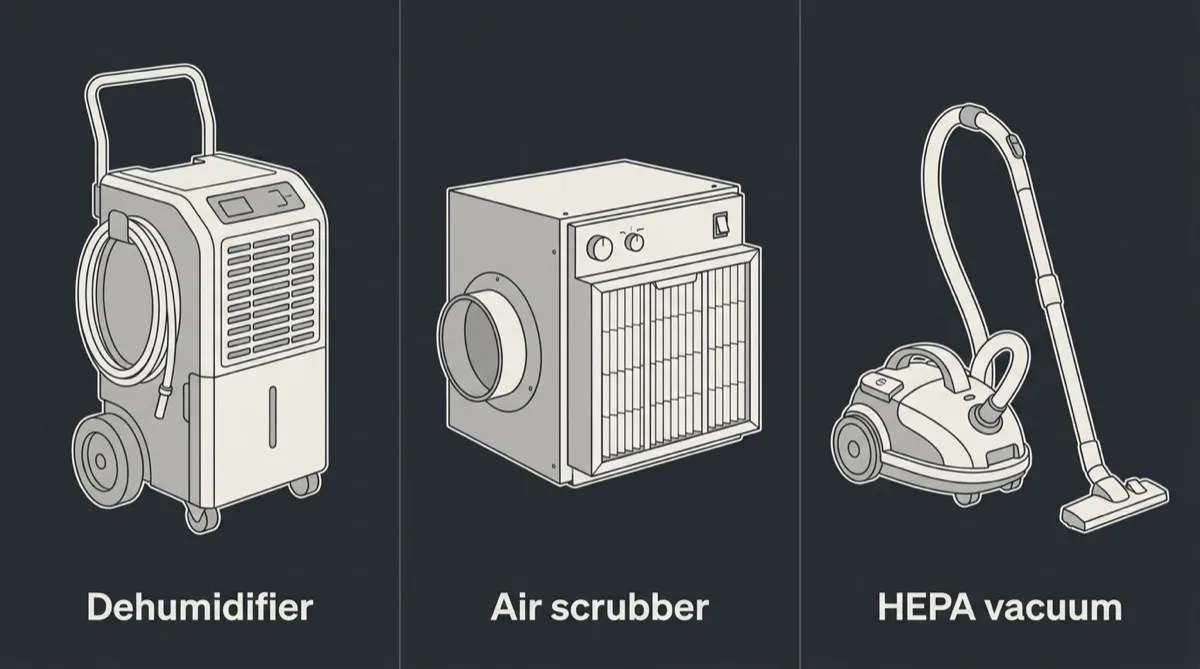
A self-managed dry-out is priced by the day. An LGR dehumidifier rents for $59.99 to $89.99 per day from DryingEquipment.ca in Toronto, a 500 CFM HEPA air scrubber for $84.99 per day from Drying Equipment Rental in the GTA, and a HEPA vacuum for $80 per day from Simplex Equipment Rental.
Page last updated: By The RestorationIndex Desk
Key facts
- 01DryingEquipment.ca lists an LGR Dri-Eaz dehumidifier at $59.99 to $89.99 per day across Toronto and the GTA, delivery included during business hours.
- 02Professional structural drying with industrial equipment and monitoring runs $800 to $4,000 per job per Desa Contracting, typically across two to four days.
- 03Renting answers a Category 1 clean-water loss only: contaminated water forces removal of porous materials, which no dehumidifier changes.
- 04Equipment rental is not one of the six categories in this index, and no company page here carries a rate of any kind.
The day rates a homeowner can actually book
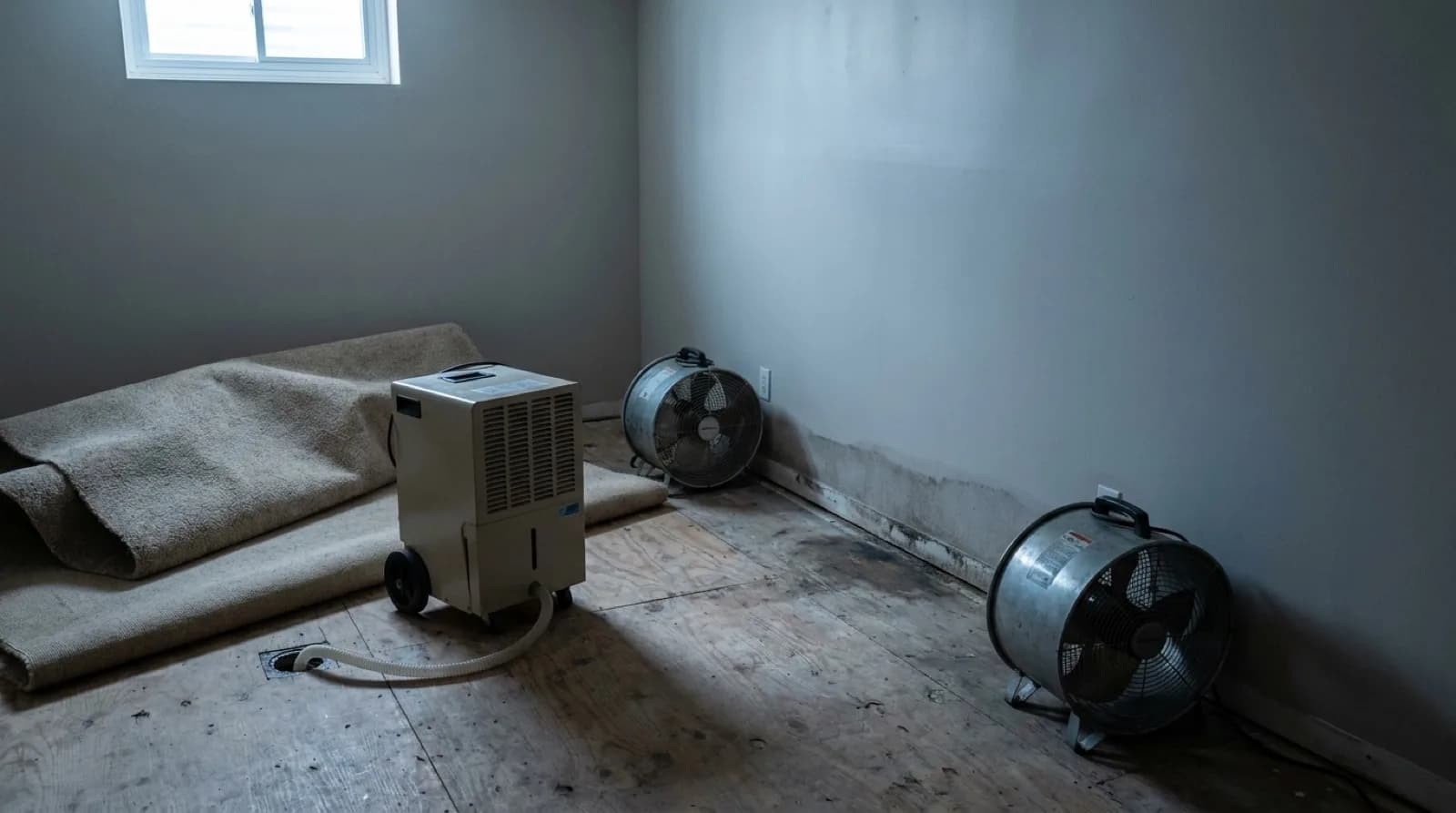
The dehumidifier is the anchor of any rental plan. DryingEquipment.ca, which delivers across Toronto and the GTA, lists a low grain refrigerant Dri-Eaz unit at $59.99 to $89.99 per day with delivery included during business hours, and the middle of that range sits around $70 per day. That rate is per machine and per day, so the cost of a dry-out is a function of how many units run and for how long, which is exactly how a contractor's invoice is built as well.
Filtration is the second line. Drying Equipment Rental in the Toronto area lists a 500 CFM HEPA air scrubber at $84.99 per day, with a floor of $60 per day on that class of machine. C&T Rentals lists the same category at $50 per day and $200 per week. Taken together, the site's mould cost data records the GTA band for an air scrubber or negative air machine as $50 to $85 per day per unit, or $200 to $350 per week. For debris and settled dust, Simplex Equipment Rental prices a professional 10 gallon HEPA vacuum at $80 per day or $252 per week, with a 45 gallon unit at $125 per day.
Weekly rates change the arithmetic on longer jobs. Simplex prices the same 10 gallon HEPA vacuum at $252 per week against $80 per day, and C&T Rentals prices its air scrubber at $200 per week against $50 per day, so a dry-out measured in days and one measured in weeks are quoted on different lines of the same price list. One rate is missing from all of this, and the gap is worth stating rather than filling. No Canadian day rate for an air mover survived into the site's dataset. The published US equipment rates were excluded rather than converted, so anyone budgeting a rental should ask the supplier directly and treat any air mover figure found online as American until proven otherwise. Every rental rate above carries 13% HST at retail, the same tax that lands on a contractor quote.
Three days of rented equipment against a hired crew
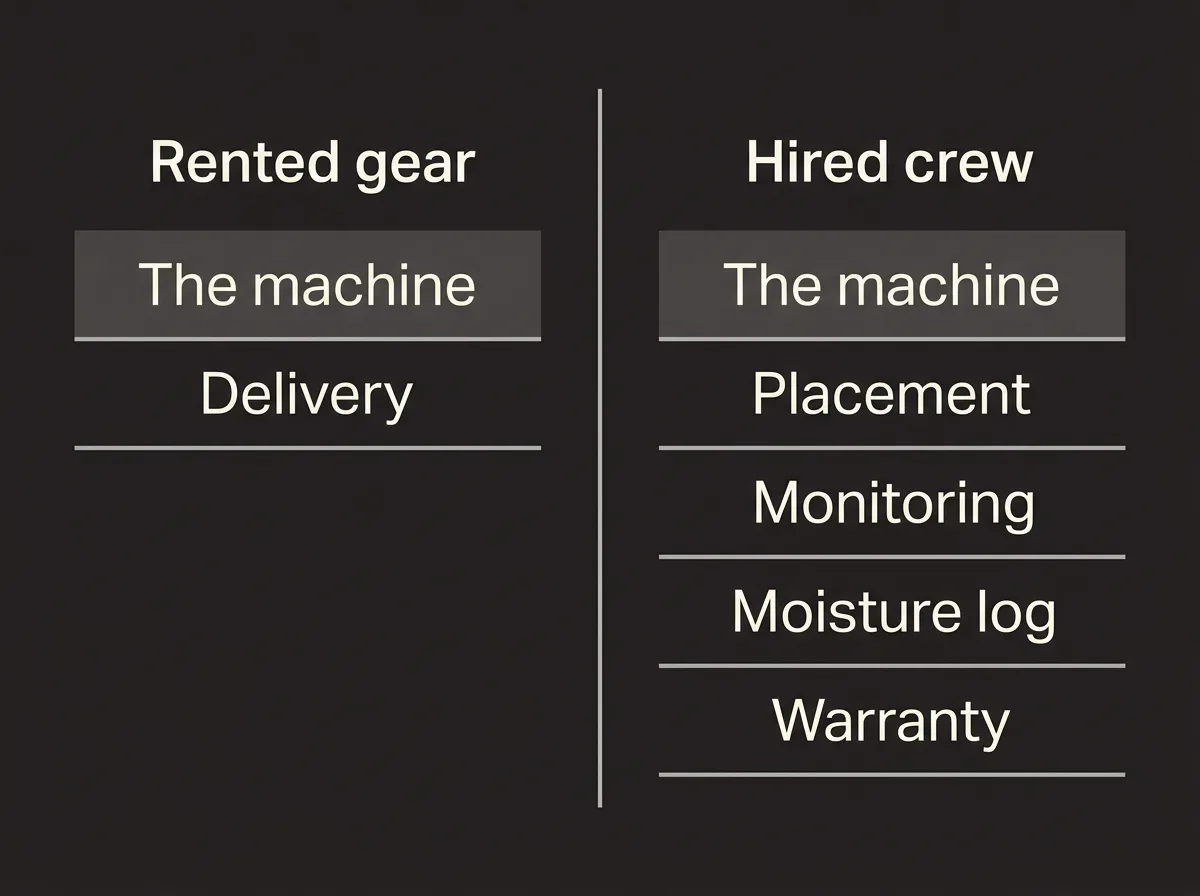
The comparison that matters is a three-day dry-out on rented gear versus the same work bought as a service. At the DryingEquipment.ca rate of $59.99 to $89.99 per day, three days of a single LGR dehumidifier comes to roughly $180 to $270 before the 13% HST. Professional structural drying and dehumidification with industrial equipment and monitoring runs $800 to $4,000 per job per Desa Contracting in Toronto, with a typical band of $1,000 to $3,000 per Ultimate Mold Crew, usually across two to four days of drying.
What the higher number buys is not more machinery. It is the decision about how many machines, where they point, how long they stay, and when the structure is actually dry. Contractor pricing tracks equipment days on site, and a typical dry-out runs 24 to 72 hours of run time, so a crew that leaves a day early and a homeowner who returns a rental a day early make the same mistake at different prices. Timing changes the contractor side only: Desa Contracting adds $150 to $500 for night and weekend emergency response and $250 to $1,000 for holiday or overnight calls, on top of the job cost. A rental counter does not charge that premium, but it also keeps business hours.
Where the rental route stops paying
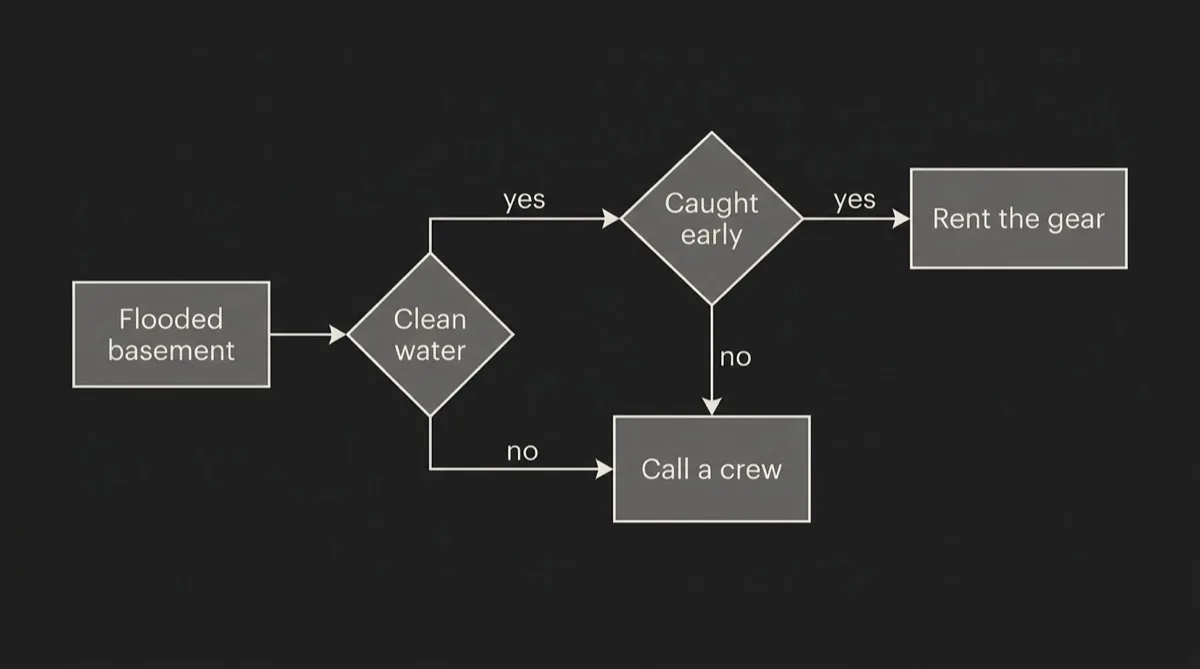
Rented equipment answers one scenario, which is a Category 1 clean water leak from a supply line or an appliance hose. Those jobs price out at $1,000 to $4,000 professionally per The Sewer and Drain in Toronto, with the low end from Desa Contracting, so the rental saving is real when the water is clean and shallow. Category 2 grey water from a washing machine or dishwasher overflow runs $4,000 to $6,500 per The Sewer and Drain because sanitization is part of the scope. Category 3 black water and sewage runs $4,000 to $30,000 and above, with a typical band of $6,000 to $12,000 per The Sewer and Drain, widened with Desa Contracting and Ultimate Mold Crew figures.
The reason the last two cannot be rented away comes down to the material rather than the machinery. Contaminated water forces removal and disposal of porous materials rather than drying them, and no dehumidifier changes what happens to soaked drywall, insulation and carpet padding that sat in grey or black water. Delay does the same thing to a clean water job. Mould can start inside 24 to 48 hours, and remediation added after that point runs $1,500 to $6,000 and above per Ultimate Mold Crew in Toronto, which erases the rental saving several times over. The other trap is calling the job finished early, since a surface that feels dry to the hand can still hold water a meter would find.
What a rental never covers
Drying is one line on a water damage job, and the lines around it stay the same whoever runs the machines. Desa Contracting in Toronto prices water damage cleanup all in at $3 to $12 per square foot, with a typical band of $4 to $10, which is the figure that absorbs extraction, drying, tear-out and cleanup together. A rented dehumidifier only touches the drying share of that, so a homeowner comparing $59.99 to $89.99 per day against a full quote is comparing one component with a whole scope.
Tear-out and rebuild are the components most likely to surprise. Drywall removal and replacement after water damage runs $300 to $4,000 per Ultimate Mold Crew in Toronto, with the low end covering a small patch per Desa Contracting and the upper end covering a full room or more. Rebuild and structural repairs after drying, including flooring, baseboards and insulation, run $2,000 to $20,000 and above per Ideal Response in Ontario, with the high end matching Desa Contracting's complete rebuild range. Material choice moves it further: replacing hardwood costs $2,000 to $8,000 and laminate $800 to $2,500 per the Toronto water damage cost data, against bare concrete, which costs nothing to replace.
There is an insurance reason the rental route appeals on small jobs. Ontario water losses commonly carry a deductible of $1,000 to $2,500 per ThinkInsure, so a clean water leak dried on rented equipment can land near or below the deductible and stay off the claims record. That calculation only holds while the job stays inside Category 1 and inside the first day or two.
What the index records, and what it does not
This directory holds 294 restoration companies across six categories: water damage restoration, mould removal, basement flood cleanup, fire and smoke restoration, sewage backup cleanup, and mould inspection and testing. Equipment rental is not among them. Of the 294 records, 258 list water damage restoration and 37 list basement flood cleanup, a hub merged into water damage restoration in August 2026 because every company under it was already listed there. The rental firms quoted above appear here as published price sources rather than as listings.
Where those companies sit matters for how fast a rental decision has to be made, because the alternative to renting is a crew that has to travel. The heaviest concentrations in the index are 38 companies in Islington-City Centre West, 25 in Burlington, 19 in Willowdale and 17 in Don Mills. None of that says anything about availability during a storm week, which the index does not track.
The contact data explains how a rental comparison has to be run. Phone numbers exist on 291 of the 294 records and websites on 259, while email addresses exist on none of them. Pricing is not a field the index holds either, so no company page carries a rate. Anyone weighing a rental against a quote is making phone calls and reading the price guides published by a handful of Toronto firms, several of which appear in the index themselves. One caution applies to every professional figure quoted here: most of the large GTA restoration firms publish no prices at all, offering a free on-site estimate and billing the insurer directly against a scoped estimate, so the ranges that exist in public come from mid-sized firms that maintain pricing pages. They work as market anchors for a rental comparison and nothing more. The published Toronto ranges for the professional side are collected under water damage restoration cost in Toronto, and the companies themselves are listed across the GTA, ordered by the RestorationIndex Score.
Frequently asked questions
What does an LGR dehumidifier cost per day in Toronto?
- DryingEquipment.ca lists $59.99 to $89.99 per day for an LGR Dri-Eaz dehumidifier, delivered within business hours across Toronto and the GTA. The middle of that range is about $70 per day. Rentals are priced per unit, so a basement needing two machines doubles the daily line. Add 13% HST, which applies to equipment rentals at retail the same way it applies to contractor labour.
How many days should equipment run?
- The site's Toronto data describes a typical dry-out as 24 to 72 hours of equipment run time, and professional structural drying jobs as two to four days. Neither figure is a promise for a specific basement. Depth, material and airflow all move it, and the only way to close the question is a moisture meter reading on the material itself rather than a surface that feels dry.
Can renting handle a sewage backup?
- No. Category 3 water requires removal and disposal of porous materials plus full disinfection, which is why those jobs run $4,000 to $30,000 and above per The Sewer and Drain, with a typical band of $6,000 to $12,000. Drying equipment does not decontaminate anything. The same limit applies to grey water from appliance overflows, priced at $4,000 to $6,500 by the same source.
What happens if the drying is started late?
- Cost moves from the drying column to the remediation column. Mould can begin within 24 to 48 hours of the water event, and Ultimate Mold Crew in Toronto prices remediation added after a delayed dry-out at $1,500 to $6,000 and above. That figure sits on top of the extraction and drying already owed, which is why the rental saving is fragile rather than fixed.
Figures on this page, and where each one comes from
An LGR Dri-Eaz dehumidifier rents at $59.99 to $89.99 per day across Toronto and the GTA, with delivery included during business hours.
DryingEquipment.ca, via this site's water damage cost research
A 500 CFM HEPA air scrubber rents at $84.99 per day, and the GTA band for an air scrubber or negative air machine is $50 to $85 per day per unit or $200 to $350 per week.
Drying Equipment Rental and C&T Rentals, via this site's mould removal cost research
A professional 10 gallon HEPA vacuum rents at $80 per day or $252 per week, with a 45 gallon unit at $125 per day.
Simplex Equipment Rental, via this site's mould removal cost research
Professional structural drying and dehumidification with industrial equipment and monitoring runs $800 to $4,000 per job, with a typical band of $1,000 to $3,000 across two to four days.
Desa Contracting and Ultimate Mold Crew (Toronto), via this site's water damage cost research
Ontario water losses commonly carry a deductible of $1,000 to $2,500.
ThinkInsure, via this site's insurance research
Keep reading
Check a company before you call it
Every profile on RestorationIndex carries the hours the firm posts, its public Google review record and a quote request.
Open the directory