Skip to content
RestorationIndex

How Much Does Basement Flood Cleanup Cost in Toronto in 2026?

Flooded basement cleanup runs about $4 to $12 per square foot all-in in Toronto, according to Desa Contracting. Restoration Mate prices a single-area job at $1,500 to $3,500 and a full finished-basement restoration with rebuild at $5,000 to $25,000, while Ultimate Mold Crew says basement water damage commonly costs $2,500 to $10,000 and up. Emergency pump-out adds $500 to $3,000.

Page last updated: By The RestorationIndex Desk
What are the headline prices?

  • $500$3,000 per jobEmergency water extraction and basement pump-out (Desa Contracting (Toronto))
  • $4$12 per sq ftFlooded basement cleanup, all-in rate (Desa Contracting (Toronto))
  • $1,500$3,500 per jobMinor flood cleanup: a single area or a few small areas (Restoration Mate (Toronto))
  • $2,500$10,000+ per jobBasement water damage, moderate to significant (Ultimate Mold Crew (Toronto))
  • $5,000$25,000 per jobFull finished-basement flood restoration including rebuild (Restoration Mate (Toronto))
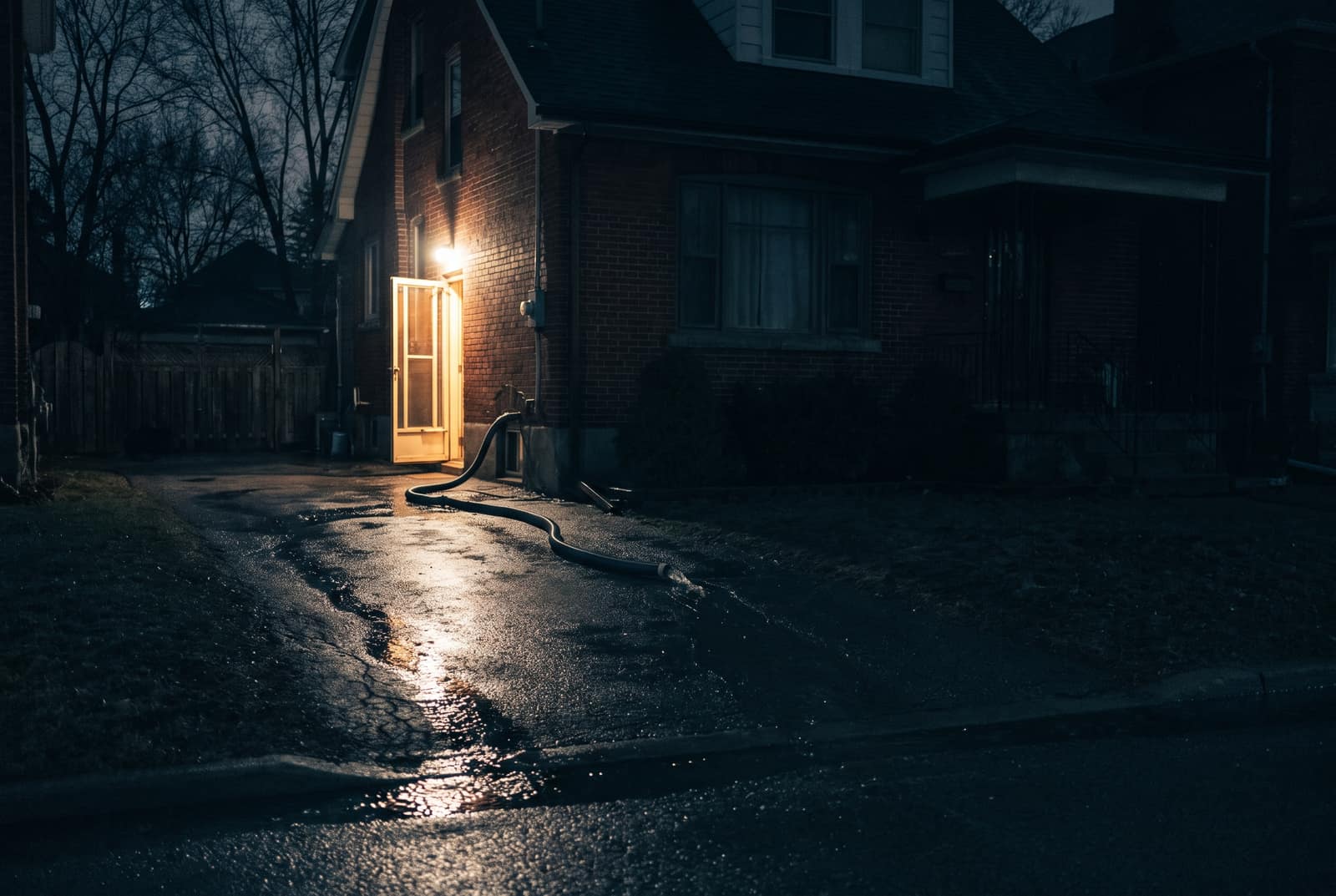
A Toronto brick house at night seen from the driveway, nobody in the frame. The side door stands open with warm light spilling out, a sump discharge hose runs out across the wet asphalt, and water tracks down the slope toward the street.
Illustration of a basement flood cleanup scene, generated for this guide. It is not a photograph of a real job, no company listed on this site appears in it, and it carries no figure. The photographs further down the page are real and are credited to the companies that published them.

Can I price my own basement flood cleanup job?

Yes, to within the range the table below publishes. Enter the size of what you are dealing with and these work it out against the same source-cited rates, so the number you get is the published market applied to your job rather than a national average.

What does basement flood cleanup cost by severity?

This range rests on 5 independent published sources, across 13 price rows. Where two of them disagree, each row carries the figure of the source it names rather than a band stretched across both, and a figure that was not in its named source was removed.

Read the note under each figure before you compare it with a quote. All 13 rows below carry the caveat their own source attached to the number: what the price does and does not cover, where it is a floor rather than a band, and who has to already be on site for it to hold. That caveat is the usual reason two honest basement flood cleanup bids differ.

Basement Flood Cleanup prices in Greater Toronto Area, re-checked August 2026 against 5 independent Canadian sources. Canadian dollars, a named source on every row, 13% HST on top unless the row says otherwise. 13 of 13 rows also print the caveat their source attached to the figure.

Emergency water extraction and basement pump-out

Typical range
$500$3,000
Unit
per job
Source
Desa Contracting (Toronto)

What the source attaches to it

Extraction only, before drying or tear-out. The same firm prices material removal separately at the same $500 to $3,000.

Flooded basement cleanup, all-in rate

Typical range
$4$12
Unit
per sq ft
Source
Desa Contracting (Toronto)

What the source attaches to it

Depends on severity and water category. Flood Services Canada prices the same work by category: $4 to $10 per sq ft for clean water, $6 to $8 for grey, $8 to $10 for black.

Minor flood cleanup: a single area or a few small areas

Typical range
$1,500$3,500
Unit
per job
Source
Restoration Mate (Toronto)

What the source attaches to it

Stated by the source as what a single-area job typically runs, not as a floor and ceiling for all small jobs.

Basement water damage, moderate to significant

Typical range
$2,500$10,000+
Unit
per job
Source
Ultimate Mold Crew (Toronto)

What the source attaches to it

Open-ended at the top; the source describes this as what basement water damage commonly costs rather than a hard band.

Full finished-basement flood restoration including rebuild

Typical range
$5,000$25,000
Unit
per job
Source
Restoration Mate (Toronto)

What the source attaches to it

A full basement, cleanup and rebuild together. The same source puts a whole-house project at $30,000 to $60,000.

Sewage backup and Category 3 black-water cleanup

Typical range
$5,000$30,000+
Unit
per job
Source
Desa Contracting (Toronto)

What the source attaches to it

Open-ended at the top. Contaminated porous material has to be removed and disposed of rather than dried, which is what separates this from a clean-water job.

Structural drying and dehumidification (industrial fans and dehumidifiers)

Typical range
$800$4,000
Unit
per job
Source
Desa Contracting (Toronto)

What the source attaches to it

Billed by equipment-days on site, so a slow-drying finished basement costs more than a fast unfinished one of the same size.

Structural disinfection and deodorizing

Typical range
$200$1,000
Unit
per job
Source
Desa Contracting (Toronto)

What the source attaches to it

A separate line item from drying. The same firm prices mold prevention treatment separately at $200 to $800.

Tear-out and removal of soaked drywall, flooring and insulation

Typical range
$500$3,000
Unit
per job
Source
Desa Contracting (Toronto)

What the source attaches to it

Removal only. Putting the material back is quoted separately, at $1,000 to $20,000+ for a complete rebuild by the same firm.

Sump pump replacement

Typical range
$800$1,500
Unit
per replacement
Source
Wright Restorations (GTA, 2026)

What the source attaches to it

Quoted by the source as an add-on to a restoration job rather than as a standalone plumbing call, and it does not include excavating a new pit.

City of Toronto Basement Flooding Protection Subsidy, maximum per property

Typical range
$6,650$6,650
Unit
rebate ceiling per property
Source
City of Toronto

What the source attaches to it

Nobody is paid $6,650 for one device. The City pays 80% of the invoiced cost, capped per item: $1,600 per backwater valve (maximum two), $2,250 for a sump pump, $500 for a one-time plumbing assessment, $300 for a sump-pump battery backup, $400 for severing and capping weeping tiles. Those caps apply to work completed on or after November 12, 2025; earlier work is capped at $1,250 per backwater valve and $1,750 per sump pump. You must be the registered owner and apply within two years of the installation.

City of Toronto subsidy for a sump pump installation

Typical range
$2,250$2,250
Unit
rebate ceiling, one device
Source
City of Toronto

What the source attaches to it

A ceiling, not a payment: the City pays 80% of the invoiced cost up to $2,250 for one device, and only for work completed on or after November 12, 2025. Earlier work is capped at $1,750.

City of Toronto subsidy for a sump pump battery backup

Typical range
$300$300
Unit
rebate ceiling, one device
Source
City of Toronto

What the source attaches to it

An additional subsidy on top of the sump pump one, again at 80% of the invoiced cost, and only where a battery backup is actually installed or retrofitted.

Which basement flood cleanup figures are firm, and which are a wide range?

Some rows on this page are money coming back rather than money going out. The City of Toronto subsidy ceilings are drawn apart from the cleanup work below, because a ceiling on a rebate is not a price for anything.

12 of the 13 priced rows on this page are drawn to scale below, grouped so that only rows priced on the same basis ever share an axis. A bar starts at the low figure its source published and ends at the high one, so its length is how much room the scope leaves. That is the part of a quote there is anything to argue about.

Quoted as one figure, not as a rate

  • Structural disinfection and deodorizing$200$1,000

    per job

  • Emergency water extraction and basement pump-out$500$3,000

    per job

  • Tear-out and removal of soaked drywall, flooring and insulation$500$3,000

    per job

  • Structural drying and dehumidification (industrial fans and dehumidifiers)$800$4,000

    per job

  • Sump pump replacement$800$1,500

    per replacement

  • Minor flood cleanup: a single area or a few small areas$1,500$3,500

    per job

  • Basement water damage, moderate to significant$2,500$10,000+

    per job

  • Full finished-basement flood restoration including rebuild$5,000$25,000

    per job

  • Sewage backup and Category 3 black-water cleanup$5,000$30,000+

    per job

Log scale: every step along the axis multiplies, it does not add.

Money coming back, not out: published rebate and subsidy ceilings

  • City of Toronto subsidy for a sump pump battery backup$300$300

    rebate ceiling, one device. One published figure, not a range.

  • City of Toronto subsidy for a sump pump installation$2,250$2,250

    rebate ceiling, one device. One published figure, not a range.

  • City of Toronto Basement Flooding Protection Subsidy, maximum per property$6,650$6,650

    rebate ceiling per property. One published figure, not a range.

Log scale: every step along the axis multiplies, it does not add.

2 bars fade out at the right instead of stopping. That is a range whose source published a floor for the top and no ceiling, written here the way the source wrote it, with a trailing plus sign. The bar is drawn only as far as the figure that was actually published. How much further it runs is the question to put to the contractor before signing.

Rows not drawn to scale

  • $4$12 per sq ft. Flooded basement cleanup, all-in rate. The only row on this page quoted by floor area, and one bar on its own is not a comparison.

Who pays for a flooded basement in Ontario?

Not the standard policy, which is the part most homeowners find out on the day. Basement flooding is excluded by default here and reaches an insurer only through an endorsement bought in advance, and there are two of them for two different ways the water gets in.

  1. A standard Ontario policy

    What is covered without buying anything extra.

    • Not basement flooding: it is excluded by default
    • Sewer backup and overland water are optional endorsements, not standard coverage
  2. An endorsement, if it was bought first

    Two separate riders for two separate routes in.

    • Sewer backup: water backing up through the drains or a failed sump
    • Overland water: surface water from rain or snowmelt entering the home
    • Which of the two pays depends on how the water got in
    • Some homes in high-risk flood zones do not qualify at all
  3. The homeowner, either way

    What lands on you before anything is reimbursed.

    • The deductible on a covered claim
    • The entire cleanup, where neither endorsement was in place
    • Prevention hardware up front, with the City subsidy paying a share of the invoice back afterwards

What drives the price?

Scope, contamination and access, in that order. Below is what moves basement flood cleanup pricing most in Toronto, each one drawn from a source named in the table above, so you can read a quote and see where the money goes.

  • Water category: Category 1 (clean supply-line water) is cheapest; Category 2 grey water adds disinfection; Category 3 sewage/river water adds full PPE, disposal of all porous materials and 40-60% higher cost.
  • Water depth and spread: every extra inch extends extraction, drying time and the tear-out line (flooring only vs drywall vs electrical/HVAC).
  • Basement size and finish level: finished basements with drywall, carpet, and furniture cost several times more than unfinished concrete storage space.
  • Response time: mold can begin growing within 24-72 hours; waiting past 72 hours typically adds $1,500-$6,000+ of mold remediation to the bill.
  • Drying duration: industrial air movers and dehumidifiers are billed per equipment-day, and Desa Contracting prices the whole drying phase at $800 to $4,000
  • Timing of the call: after-hours, overnight, and holiday emergency response adds $150-$500+ in surcharges (up to $1,000 on holidays per DeSa Contracting).
  • Contents volume: pack-out, cleaning, and disposal of belongings is often quoted separately from structural cleanup.
  • Insurance vs cash: insurer-billed scopes follow standardized pricing; cash customers can negotiate but carry the full reconstruction risk.
  • Reconstruction scope: rebuild (drywall $300-$1,200, laminate $800-$2,500, hardwood $2,000-$8,000) frequently exceeds the cleanup cost itself.

What's specific to Ontario and Toronto?

Three things: 13% HST on every quote, a City of Toronto rebate on prevention work, and no provincial licence for this trade at all. National price guides miss all three.

  • Standard Ontario home insurance does NOT cover basement flooding by default. Sewer backup coverage (water backing up through drains/sump) and overland water coverage (surface water from rain/snowmelt entering the home) are separate optional endorsements: you need the right one for how the water got in.
  • Endorsement pricing: sewer backup riders typically run $20-$250 per year in Ontario (McDougall Insurance/isure); overland water coverage runs roughly $10-$30 per month in lower-risk areas (isure), and homes in high-risk flood zones may pay much more or not qualify at all.
  • Insurers commonly discount premiums or require mitigation for homes with a backwater valve and battery-backed sump pump: keep installation invoices and City subsidy paperwork as proof.
  • City of Toronto Basement Flooding Protection Subsidy (official toronto.ca amounts for work completed on/after Nov 12, 2025; applications from May 1, 2026): up to 80% of invoiced cost per item: backwater valve max $1,600 per device (up to two devices), sump pump max $2,250 (one device), sump battery backup max $300, pipe severance and capping max $400, home plumbing assessment max $500; program total up to $6,650 per property; apply within two years of the work.
  • A City plumbing permit is required for backwater valve installation, and subsidy-eligible work must be done by a licensed contractor; the subsidy maximums include labour, materials, permit and taxes.
  • HST: restoration and plumbing quotes in Ontario are usually given before 13% HST: add it when comparing quotes to insurance scopes, which are typically HST-inclusive.
  • Health Canada's residential indoor air quality guidance treats all mould as a health hazard regardless of species: there is no 'safe' level; Health Canada/CMHC guidance says small patches (under about 1 square metre) can be cleaned DIY with precautions, while larger post-flood growth warrants professional remediation.
  • Ontario has NO licensing requirement for mold remediation or water damage restoration: anyone can call themselves a restoration company. Look for voluntary IICRC certification (WRT: Water Damage Restoration Technician, ASD: Applied Structural Drying, AMRT: Applied Microbial Remediation) and insurer-approved vendor status as the practical quality signals.
  • After a widespread storm, register your claim with your insurer immediately: restoration capacity in the GTA runs out fast (the July 2024 storm generated ~$940M in insured losses per the Insurance Bureau of Canada) and insurers dispatch in claim order.

How can I pay less?

Act inside the first 24 to 48 hours, get more than one quote, and claim every rebate you qualify for. Those three do more than anything else on this list. Each lever below is tied to a real number in the table above.

  • Claim the City of Toronto subsidy for prevention: up to $6,650 per property (backwater valve $1,600 each, sump pump $2,250, battery backup $300): a subsidized backwater valve is far cheaper than one $10,000 sewage cleanup.
  • Call your insurer before signing anything: if you carry sewer backup or overland water endorsements, the insurer assigns or approves the restoration firm and you pay only your deductible.
  • Act within 24-48 hours: fast extraction and drying keeps a $2,500 job from becoming a $8,000+ job with mold remediation added.
  • For clean water under about an inch, extracting and drying it yourself is worth pricing against a professional job: Desa Contracting prices professional drying at $800 to $4,000 and extraction at $500 to $3,000. Never DIY sewage or storm water.
  • Get 2-3 quotes for the rebuild phase: cleanup is urgent, reconstruction is not; separating them lets you bid out drywall and flooring competitively.
  • Haul ruined contents away yourself or with an independent junk hauler rather than paying the restoration firm disposal line item. This page no longer quotes a truckload price: the hauler it used to cite publishes none.
  • Photograph and video everything before disposal and keep receipts: thorough documentation prevents claim disputes on contents value.
  • Ask about the pipe severance/capping subsidy ($400) and downspout disconnection: cheap changes that reduce recurrence risk and can earn insurance premium discounts.

How did we research these numbers?

By opening every source and finding the sentence that carries the figure. Every row on this page records the source it came from, the literal sentence in that source, and where that sentence sits in a cached copy of the page; a build gate reopens the cache and re-finds it. A figure whose source could not be read was removed rather than republished, and no number was adjusted to make an attribution true.

  • Every figure in the table above was re-checked in August 2026 against the cached text of the page it is attributed to, and each row records the source sentence it came from. Where a range was not in its named source it was replaced by that source own published figure, or the row was removed. No number was moved to make an attribution true.
  • The sewage row used to read $4,000 to $30,000+, a band these notes admitted had been combined from two firms. Desa Contracting, the source named on the row, publishes $5,000 to $30,000+. Ultimate Mold Crew publishes $4,000 to $15,000+ for the same work. The disagreement is real and is stated here rather than averaged into the row.
  • Four rows were deleted. Three sump-pump rows (replacement, new install with pit, battery backup) all rested on Premier Plumbing, whose pages now answer every non-browser request with a SiteGround captcha wall, so none of the figures can be checked. A contents-disposal row cited Junk Professionals, whose pricing page carries no truckload price at all. One replacement row was added: Wright Restorations publishes $800 to $1,500 for a sump pump replacement, and that is now the only sump-pump figure on the page.
  • The subsidy row is a ceiling, not a payment. The City pays 80% of invoiced cost with a separate cap on each item, so no property is paid $6,650 for one device. The per-item caps are in the row condition.
  • A US source that had been used for the depth and size framework (Advanced DRI) states on its own page that its data reflects 2026 pricing in the Northeast US. It carries no figure on this page now, converted or otherwise.
  • Flood Services Canada, a Toronto firm, prices flood cleanup by water category: $4.00 to $10.00 per square foot for clean water, $6.00 to $8.00 for grey water, and $8.00 to $10.00 for black water.
  • Insurance-claim averages sit far above cash cleanup prices because they include full reconstruction and contents. Treat published contractor ranges as market anchors for a cash job, not as claim values.
  • Most large GTA restoration firms publish no flat prices at all and bill insurers directly, so the ranges above come from mid-size firms that publish a pricing page.
  • Add 13% HST: Ontario restoration and plumbing quotes are usually given before tax.

Sources

Who can do the work?

The photographs below belong to the basement flood cleanup companies this site's published score puts at the top: their own vans, premises and jobs, as published on their own Google listings and read in July 2026. Nothing here was shot for this page.

  • A worker in a white protective suit and a full-face respirator crouching between roof trusses in an attic, vacuuming the boards with a canister unit, lit by one clamped work light
  • A hand holding a thermal imaging camera up to a bedroom wall, the screen showing a cold blue patch spreading across an otherwise warm surface
  • A white CPR24 Restoration van parked in the driveway of a two-storey Toronto house on a clear day
  • Three blue air movers running on a bare concrete basement floor, in front of a stud wall stripped back to the insulation with the drain stack exposed
  • A sheet of drywall pulled away from a kitchen wall and leaning on the floor, its lower third black and brown with mould growth
  • A worker in a white suit and an air-fed respirator spraying between the joists of a brick-walled crawl space

6 of the photographs these companies publish themselves, in the order this site's published score puts them: Canada's Restoration Services, Restoration Professionals, CPR24 Restoration, CPR24 Restoration of Milton, Canada's Restoration Services, TRAX Restoration.

RestorationIndex tracks 37 basement flood cleanup companies across the Greater Toronto Area, rated 4.85★ on average. The three below rank highest on our published score, based on RestorationIndex's analysis of 37 GTA businesses, July 2026.

See all 37 basement flood cleanup companies on RestorationIndex

What do the terms in a basement flood cleanup quote mean?

These are the 6 words the quotes above are written in, defined from what this page's own sources say about them. Knowing them is most of the difference between comparing two bids and guessing between them, and each one has its own link so a definition can be pointed at on its own.

Backwater valve
A one-way flap installed in the drain that closes when the city sewer tries to push water back toward the house. The City of Toronto subsidises it, at 80 per cent of the invoiced cost up to $1,600 per device for a maximum of two devices.
Sump pit
The lined hole in the basement floor that groundwater collects in before a pump lifts it out. Replacing a pump in an existing pit is a different job from digging a new pit, and the City subsidises a sump pump installation at 80 per cent of the invoice up to $2,250.
Basement Flooding Protection Subsidy
The City of Toronto rebate for flood prevention work, never for cleanup. It pays 80 per cent of the invoiced cost with a separate cap on each item, up to $6,650 per property, and it applies to City of Toronto addresses only.
Overland water coverage
The optional Ontario endorsement for surface water from rain or snowmelt entering the house at grade. It is a different rider from sewer backup coverage, and which of the two pays depends on how the water got in rather than where it ended up. Neither is part of a standard policy.
Tear-out line
How far up the wall the demolition goes: the flooring, drywall and insulation that took the water and now come out before anything is dried or rebuilt. Where that line is drawn decides how much of the rebuild follows it, which is why an extra inch of standing water is not a small difference.
Insurer-approved vendor
A restoration firm an insurer keeps on its own list and dispatches to claims. Where the loss is covered the insurer usually assigns or approves the firm and the homeowner pays the deductible, which is why the first call after a flood is to the insurer rather than to a contractor.

What should I ask a basement flood cleanup contractor before signing?

  • How fast can you start pumping out and extracting the water?
  • Will you document everything for an insurance claim, including sewer-backup coverage? Price your own job with the flooded basement cleanup cost
  • How do you decide what gets dried and saved versus removed (drywall, insulation, flooring)?
  • How will you check for and prevent mold once the basement is dry?
  • Can you advise on backwater valves or sump pumps to reduce the next flood?

What else do people ask about basement flood cleanup costs?

How much does it cost to clean up a flooded basement in Toronto?

Desa Contracting charges roughly $4 to $12 per square foot all-in. Restoration Mate puts a single-area job at about $1,500 to $3,500 and a full finished basement, cleanup and rebuild together, at $5,000 to $25,000. Ultimate Mold Crew says basement water damage in Toronto commonly costs $2,500 to $10,000 or more. Sewage backups cost the most by far.

What does an emergency pump-out of a flooded basement cost?

Professional water extraction in Toronto runs about $500-$3,000 depending on water volume and basement size, per DeSa Contracting's 2025 Toronto guide. Expect an extra $150-$500 after-hours or overnight surcharge. Most GTA restoration firms respond 24/7 within an hour and bill your insurer directly if you have coverage.

How much does sewage backup cleanup cost in Toronto?

Category 3 sewage cleanup is the priciest scenario: Toronto firms publish $4,000-$15,000+ (Ultimate Mold Crew) up to $5,000-$30,000+ (DeSa Contracting) because all porous materials must be discarded and the space fully disinfected. A sewer backup insurance endorsement, typically $20-$250 per year in Ontario, usually covers this minus your deductible.

Does home insurance cover a flooded basement in Ontario?

Not by default. You need optional endorsements: sewer backup coverage (about $20-$250 per year) for water backing up through drains, and overland water coverage (roughly $10-$30 per month in lower-risk areas) for rain or snowmelt entering the home. The average urban flooded-basement claim is about $42,000, so both are worth pricing.

How much does it cost to replace a sump pump in Toronto?

This page no longer publishes a Toronto sump pump installation price. The plumbing guide it used to cite now blocks every non-browser request, so the figures could not be re-checked, and nothing was substituted for them. The one sump-pump figure that survives is Wright Restorations $800 to $1,500 for a replacement as part of a restoration job. The City of Toronto subsidy refunds 80% of the cost to a maximum of $2,250 for an eligible sump pump installation.

What does the City of Toronto give you for basement flood protection in 2026?

As of May 1, 2026 the Basement Flooding Protection Subsidy pays up to $6,650 per property: $1,600 per backwater valve (up to two), $2,250 for a sump pump, $300 for a battery backup, $400 for pipe severance and capping, and $500 for a home plumbing assessment. Apply within two years of the work.

How much does drying out a basement cost after a flood?

Structural drying with industrial air movers and dehumidifiers costs about $800 to $4,000 in Toronto, per Desa Contracting. Skipping proper drying is false economy: mold starts within 24 to 72 hours and Ultimate Mold Crew puts remediation after water damage at $1,500 to $6,000 or more on top.

Is it cheaper to clean up a flooded basement myself?

For clean water under about an inch it can be, and the comparison worth making is against Desa Contracting published $500 to $3,000 for professional extraction and $800 to $4,000 for professional drying. Grey water, sewage, or anything that sat over 48 hours needs certified crews: botched DIY commonly ends in a mold remediation bill of $1,500 to $6,000 or more on top.

What else should I read before booking basement flood cleanup?

Who handles basement flood cleanup in the GTA?

Every company on the list below its own page shows its hours, its area and a quote request.

See basement flood cleanup