Skip to content
RestorationIndex

How Much Does Fire & Smoke Restoration Cost in Toronto in 2026?

Smoke and soot removal costs about $2,000 to $15,000 in Toronto, according to Restoration Mate, while a small contained kitchen fire runs $8,000 to $25,000 per 24/7 Remedial Services. Contents pack-out and cleaning adds $2,000 to $20,000, and full reconstruction after a severe structural fire reaches $200 to $500 per square foot.

Page last updated: By The RestorationIndex Desk
What are the headline prices?

  • $500$3,000 per incidentEmergency board-up and roof tarping (Restoration Mate (Toronto))
  • $200$500 per inspectionFire damage inspection and initial assessment (911 Water Damage Experts (Canada))
  • $2,000$15,000 per projectSmoke and soot removal (Restoration Mate (Toronto))
  • $500$3,000 per homeOdour removal and air scrubbing package (Restoration Mate (Toronto))
  • $200$1,000 per jobDeodorizing services (line item) (911 Water Damage Experts (Canada))
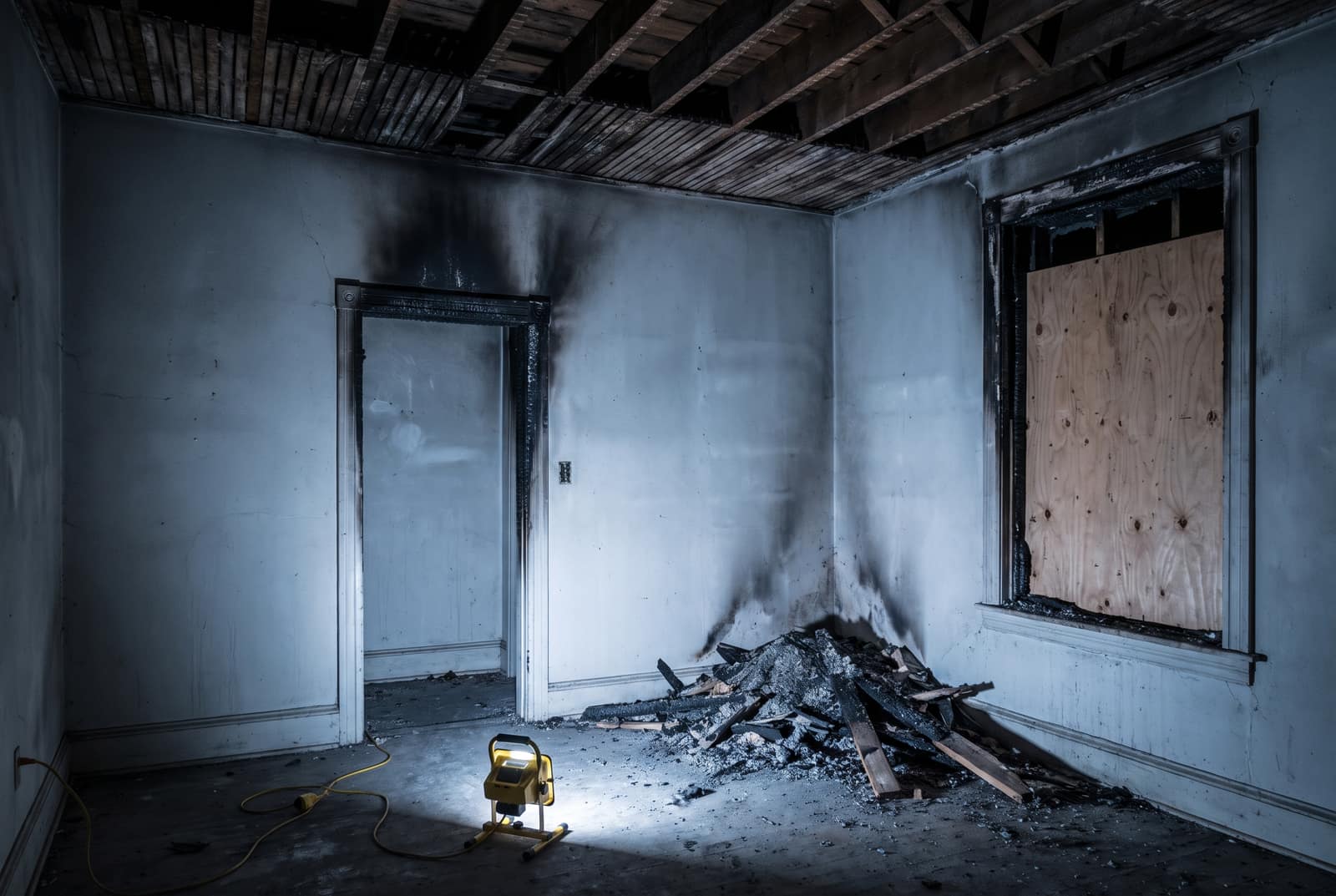
The inside of a fire-damaged room at night, long after the fire is out. Soot has blackened the wall in a plume above a charred doorway, the ceiling is stripped back to bare joists, plywood covers a burnt-out window, and debris is swept into one pile beside a single work light on the floor.
Illustration of a fire and smoke restoration scene, generated for this guide. It is not a photograph of a real job, no company listed on this site appears in it, and it carries no figure. The photographs further down the page are real and are credited to the companies that published them.

Can I price my own fire and smoke restoration job?

Yes, to within the range the table below publishes. Enter the size of what you are dealing with and these work it out against the same source-cited rates, so the number you get is the published market applied to your job rather than a national average.

What does fire and smoke restoration cost by loss size?

This range rests on 3 independent published sources, across 12 price rows. Where two of them disagree, each row carries the figure of the source it names rather than a band stretched across both, and a figure that was not in its named source was removed.

Read the note under each figure before you compare it with a quote. All 12 rows below carry the caveat their own source attached to the number: what the price does and does not cover, where it is a floor rather than a band, and who has to already be on site for it to hold. That caveat is the usual reason two honest fire and smoke restoration bids differ.

Fire & Smoke Restoration prices in Greater Toronto Area, re-checked August 2026 against 3 independent Canadian sources. Canadian dollars, a named source on every row, 13% HST on top unless the row says otherwise. 12 of 12 rows also print the caveat their source attached to the figure.

Emergency board-up and roof tarping

Typical range
$500$3,000
Unit
per incident
Source
Restoration Mate (Toronto)

What the source attaches to it

The securing step only, before any cleaning starts. Insurers normally treat it as emergency mitigation and expect it done immediately.

Fire damage inspection and initial assessment

Typical range
$200$500
Unit
per inspection
Source
911 Water Damage Experts (Canada)

What the source attaches to it

Stated as a typical Canadian range and described as the first step, before any work is scoped.

Smoke and soot removal

Typical range
$2,000$15,000
Unit
per project
Source
Restoration Mate (Toronto)

What the source attaches to it

Driven by the size of the affected area and the severity of contamination. The same source prices structural cleaning and deodorization separately at $3,000 to $12,000.

Odour removal and air scrubbing package

Typical range
$500$3,000
Unit
per home
Source
Restoration Mate (Toronto)

What the source attaches to it

A package covering both, quoted per home. 911 Water Damage Experts price the two parts separately at $200 to $1,000 for deodorizing and $500 to $1,500 for air purification.

Deodorizing services (line item)

Typical range
$200$1,000
Unit
per job
Source
911 Water Damage Experts (Canada)

What the source attaches to it

Deodorizing only. Air purification with specialised air scrubbers is a separate $500 to $1,500 on the same list.

HVAC system cleaning after a fire

Typical range
$1,000$5,000
Unit
per system
Source
Restoration Mate (Toronto)

What the source attaches to it

Cleaning only. 911 Water Damage Experts say replacing damaged ductwork adds another $2,000 to $10,000.

Contents cleaning, pack-out and restoration

Typical range
$2,000$20,000+
Unit
per household
Source
Restoration Mate (Toronto)

What the source attaches to it

Open-ended at the top. Climate-controlled storage while the house is worked on is separate, at $200 to $500 per month per the same source.

Small contained kitchen or appliance fire (single room, cleanup phase)

Typical range
$8,000$25,000
Unit
per loss
Source
24/7 Remedial Services (Ontario)

What the source attaches to it

Single room, including deodorization and partial cabinet replacement.

Whole-home soot cleanup with no structural fire (furnace puff-back)

Typical range
$15,000$45,000
Unit
per loss
Source
24/7 Remedial Services (Ontario)

What the source attaches to it

No structural fire: this is soot spread through the whole house without anything having to be rebuilt.

Single-room structural fire (controlled demolition, cleanup and rebuild)

Typical range
$30,000$90,000
Unit
per loss
Source
24/7 Remedial Services (Ontario)

What the source attaches to it

Includes the structural rebuild, which is what separates this from the soot-cleanup rows above.

Major multi-room structural fire (large loss)

Typical range
$50,000$300,000+
Unit
per loss
Source
Restoration Mate (Toronto)

What the source attaches to it

Open-ended at the top; the source describes it as extensive house damage rather than a room count.

Full reconstruction after severe fire

Typical range
$200$500
Unit
per sq ft
Source
Restoration Mate (Toronto)

What the source attaches to it

Higher-end finishes and custom work sit at the top of the band. The same source works it out as $300,000 to $750,000 for a 1,500 sq ft home rebuilt completely.

Which fire and smoke restoration figures are firm, and which are a wide range?

A fire loss is quoted both as single line items and as one whole-loss figure. Both are drawn below on the same axis, with the exact unit printed under every bar, so a line item is never mistaken for the total.

11 of the 12 priced rows on this page are drawn to scale below, grouped so that only rows priced on the same basis ever share an axis. A bar starts at the low figure its source published and ends at the high one, so its length is how much room the scope leaves. That is the part of a quote there is anything to argue about.

Quoted as one figure, not as a rate

  • Fire damage inspection and initial assessment$200$500

    per inspection

  • Deodorizing services (line item)$200$1,000

    per job

  • Emergency board-up and roof tarping$500$3,000

    per incident

  • Odour removal and air scrubbing package$500$3,000

    per home

  • HVAC system cleaning after a fire$1,000$5,000

    per system

  • Smoke and soot removal$2,000$15,000

    per project

  • Contents cleaning, pack-out and restoration$2,000$20,000+

    per household

  • Small contained kitchen or appliance fire (single room, cleanup phase)$8,000$25,000

    per loss

  • Whole-home soot cleanup with no structural fire (furnace puff-back)$15,000$45,000

    per loss

  • Single-room structural fire (controlled demolition, cleanup and rebuild)$30,000$90,000

    per loss

  • Major multi-room structural fire (large loss)$50,000$300,000+

    per loss

Log scale: every step along the axis multiplies, it does not add.

2 bars fade out at the right instead of stopping. That is a range whose source published a floor for the top and no ceiling, written here the way the source wrote it, with a trailing plus sign. The bar is drawn only as far as the figure that was actually published. How much further it runs is the question to put to the contractor before signing.

Rows not drawn to scale

  • $200$500 per sq ft. Full reconstruction after severe fire. The only row on this page quoted by floor area, and one bar on its own is not a comparison.

What order does a fire loss actually get worked in?

Four stages, and they are not interchangeable. The first two are time-critical and are usually covered as reasonable steps to protect the property; the last one is not urgent at all, which is the one place a homeowner still has room to shop.

  1. 01 Make it safe

    • Call the insurer's claims line before hiring anyone
    • Emergency board-up and roof tarping
    • Ventilate and photograph, but do not wipe the soot
  2. 02 Take the water out

    • The water used to put the fire out is still water damage
    • Extraction and drying scope on top of the fire work
    • Left wet, it turns into a mould job as well
  3. 03 Clean the soot and the smell

    • Smoke and soot removal off the surfaces
    • Odour removal and air scrubbing
    • Duct cleaning, because HVAC circulation spreads it house-wide
    • Contents pack-out, cleaning and storage
  4. 04 Put it back

    • Whether demolition and rebuild are needed is the single biggest swing in the price
    • Rebuild is where per-square-foot pricing varies most
    • Cleanup is time-critical and rebuild is not, so this is the stage to take two or three quotes on

What drives the price?

Scope, contamination and access, in that order. Below is what moves fire and smoke restoration pricing most in Toronto, each one drawn from a source named in the table above, so you can read a quote and see where the money goes.

  • Soot type: dry soot from fast-burning fires is cheapest to clean; oily/protein soot from grease and kitchen fires penetrates surfaces and can double or triple cleaning cost
  • How far smoke travelled: HVAC circulation spreads contamination house-wide and adds duct cleaning ($1,000-$5,000 Canada-wide per 911 Water Damage Experts)
  • Volume of fire-suppression water: adds extraction/drying scope ($2,000-$6,000) and mould risk if not dried fast
  • Contents involvement: volume and salvageability of belongings drives pack-out, specialty cleaning, and storage costs
  • Structural vs surface damage: whether demolition and rebuild are needed is the single biggest cost swing
  • Property size and access: square footage, number of storeys, and number of openings needing board-up
  • Emergency timing: after-hours, weekend, and holiday response carries premiums
  • Insurance vs cash job: insurer-scoped (Xactimate) pricing differs from retail cash quotes

What's specific to Ontario and Toronto?

Three things: 13% HST on every quote, a City of Toronto rebate on prevention work, and no provincial licence for this trade at all. National price guides miss all three.

  • Fire and smoke damage, including damage caused by efforts to extinguish the fire, is covered by all standard Ontario homeowner, condo, and tenant policies (Insurance Bureau of Canada). You pay only your deductible on a covered claim.
  • Additional Living Expenses (ALE) coverage pays accommodation, food, and clothing costs above your normal spending while the home is unliveable; IBC's example: $500/week eating out minus $100/week normal groceries = $400/week claimable.
  • Overland water and sewer backup are optional endorsements in Ontario, not standard coverage. They matter for fire losses when basement water damage accompanies the event: base policies cover firefighting water, but water entering from outside or backing up through drains needs the endorsement.
  • Toronto's Basement Flooding Protection Subsidy now pays up to $6,650 per property for work completed on or after November 12, 2025 (up from $3,400): backwater valve up to $1,600 per device (max two), sump pump up to $2,250, sump backup power $300 (City of Toronto). Water-side prevention, but relevant to combined fire-and-water losses.
  • HST at 13% applies to all restoration labour and materials in Ontario; on personal home-insurance claims the insurer settles HST-inclusive, while GST/HST-registered businesses settle net of recoverable input tax credits.
  • Post-fire suppression water can trigger mould within days. Health Canada's moisture-and-mould guidance recommends hiring professionals for larger mould areas and recognizes IICRC certification or OSHA-equivalent training as the qualification marker.
  • Ontario has NO licensing requirement for mold remediation or inspection: anyone can claim expertise (unlike Quebec, where contractors must register with the RBQ). For fire work, look for IICRC Fire and Smoke Restoration Technician (FSRT) certification and firms following IICRC S520 (mould) and S700-series (fire) standards.

How can I pay less?

Act inside the first 24 to 48 hours, get more than one quote, and claim every rebate you qualify for. Those three do more than anything else on this list. Each lever below is tied to a real number in the table above.

  • Call your insurer's 24/7 claims line before hiring anyone: emergency board-up and mitigation are covered under virtually all policies as 'reasonable repairs to protect property', and pre-approval avoids reimbursement disputes. Keep every receipt.
  • Ventilate and photograph everything immediately, but do not wipe soot yourself: smearing oily soot into drywall, grout, or upholstery makes professional cleaning more expensive, not less.
  • For a light smoke-only event, compare the cost to your deductible first: Restoration Mate prices an odour-removal and air-scrubbing package at $500 to $3,000, often below a $1,500 to $2,500 deductible, and claiming can raise premiums.
  • Ask which odour technology is quoted and what it means for you: ozone treatment requires vacating the home, hydroxyl generators let you stay but need days of run time. This page no longer publishes prices for either, because the only source it had for them now blocks checking.
  • Get the scope itemized per room and per treatment, and get 2-3 quotes for the reconstruction phase: cleanup is time-critical, rebuild is not, and rebuild is where $200-$500/sq ft pricing varies most.
  • Triage contents ruthlessly before pack-out: cleaning and storing low-value items can cost more than replacing them, and contents restoration runs $2,000-$20,000+ per household.

How did we research these numbers?

By opening every source and finding the sentence that carries the figure. Every row on this page records the source it came from, the literal sentence in that source, and where that sentence sits in a cached copy of the page; a build gate reopens the cache and re-finds it. A figure whose source could not be read was removed rather than republished, and no number was adjusted to make an attribution true.

  • Every figure in the table above was re-checked in August 2026 against the cached text of the page it is attributed to, and each row records the source sentence it came from. Where a range was not in its named source it was replaced by that source own published figure, or the row was removed. No number was moved to make an attribution true.
  • Four odour-treatment rows were deleted. Ozone treatment, hydroxyl generator treatment, single-room odour treatment and whole-home odour treatment all rested on one page at First Response Cleaning, which now answers every non-browser request with a SiteGround captcha wall. None of those four figures can be checked, so none of them is published here any more, and no substitute number was invented. Two readable odour rows were put in their place: Restoration Mate odour removal and air scrubbing package at $500 to $3,000, and 911 Water Damage Experts deodorizing line item at $200 to $1,000.
  • The smoke and soot row used to read $1,000 to $15,000, a band these notes admitted was widened across two sources. Restoration Mate, the source named on the row, publishes $2,000 to $15,000. 911 Water Damage Experts publish $1,000 to $5,000 for professional smoke-damage cleaning, which is a lighter job, and that figure is quoted as itself rather than folded into the row.
  • Published GTA fire-restoration pricing is scarce. Most large firms scope every loss individually for the insurer and publish no numbers at all, so the ranges above come from the minority of Ontario firms that publish Canadian prices.
  • Ontario sources disagree about what a typical Toronto fire job costs, and the disagreement is the useful fact: The Best Toronto puts fire damage restoration at $4,000 to $15,000, while Restoration Mate puts fire damage restoration and rebuild for moderate damage at $10,000 to $75,000+. The first is a smoke-led job, the second includes rebuilding.
  • Reconstruction is billed separately from cleanup and tends to roughly double the cleanup figure on most claims (24/7 Remedial Services).
  • US sources were excluded rather than converted. Every figure on this page is a Canadian dollar figure from a Canadian page.
  • After-hours and weekend callouts and upper-storey access carry surcharges, and all listed prices are before 13% HST.

Sources

Who can do the work?

The photographs below belong to the fire and smoke restoration companies this site's published score puts at the top: their own vans, premises and jobs, as published on their own Google listings and read in July 2026. Nothing here was shot for this page.

  • A hand holding a moisture meter against a wall above a green drying unit, its reading bar sitting at the top of the scale
  • A finished living room with a lit gas fireplace, shuttered windows onto a suburban street, and a hardwood floor
  • A blue dehumidifier and an air mover running on a stripped basement floor, beside a wall cut back to the studs with the insulation still between them and furniture under plastic sheeting
  • Three people in masks and gloves clearing charred debris from the burnt-out rear of a single-storey house, the siding blackened and sheet metal piled on the grass
  • A flooded warehouse floor reflecting the ceiling lights, a worker in a high-visibility vest running a blue extractor beside a boom lift and racking
  • A worker in a branded hoodie kneeling beside a toilet in a tiled bathroom, the cistern lid off and set down on the floor

6 of the photographs these companies publish themselves, in the order this site's published score puts them: Select Restoration Services, Firstline Restoration, The Preferred Group Restoration (Water-Mould-Fire), Touch With Care | 24/7 Restoration in Mississauga, Pro Max Restoration, Pro Max Restoration of East York.

3 higher-placed companies were passed over here because the lead photograph is marketing creative, a before-and-after composite or a posed booth shot rather than a picture of a job. They are still in the list below and on the full fire & smoke restoration page.

RestorationIndex tracks 78 fire and smoke restoration companies across the Greater Toronto Area, rated 4.71★ on average. The three below rank highest on our published score, based on RestorationIndex's analysis of 78 GTA businesses, July 2026.

See all 78 fire and smoke restoration companies on RestorationIndex

What do the terms in a fire and smoke restoration quote mean?

These are the 6 words the quotes above are written in, defined from what this page's own sources say about them. Knowing them is most of the difference between comparing two bids and guessing between them, and each one has its own link so a definition can be pointed at on its own.

Puff-back
A furnace or boiler misfire that blows oily soot through the ductwork into every room. Nothing burns and nothing is structurally damaged, but every surface in the house carries a greasy film that bonds to paint, fabric and plastic, which is why the cleanup runs into five figures with no fire damage at all.
Pack-out
The crew inventories, photographs and removes everything portable, cleans it off site in equipment a homeowner cannot rent, stores it while the structure is worked on, and brings it back. The inventory is the document you and your insurer will argue from.
Board-up
Securing openings and tarping the roof the same night, before any cleaning starts. Most Ontario policies expect you to take reasonable steps to prevent further damage, so this is normally covered as emergency mitigation.
Protein soot
The oily residue a grease or kitchen fire leaves. It sinks into surfaces instead of sitting on them, which is why it is the expensive kind to clean, and why wiping at it before a technician arrives drives the cost up rather than down.
Additional Living Expenses
The part of an Ontario policy that pays to house you while the home is not liveable. It covers the difference between what you spend displaced and what you would normally have spent, not the whole bill, so the receipts that matter are the ones showing that gap.
FSRT
Fire and Smoke Restoration Technician, the IICRC designation for this specific work, sitting on the S700-series fire standards the way mould work sits on S520. Ontario requires no licence to advertise fire restoration, so the designation is what there is to ask for.

What should I ask a fire and smoke restoration contractor before signing?

  • Are you IICRC certified for fire and smoke restoration (FSRT)?
  • How do you remove smoke odour at the source rather than masking it?
  • What is your process for cleaning soot from surfaces and contents before it etches?
  • Do you handle board-up, contents pack-out and the structural rebuild?
  • Will you itemize the loss and work directly with my insurer? Price your own job with the fire and smoke damage cost

What else do people ask about fire and smoke restoration costs?

How much does it cost to clean up after a small kitchen fire in Toronto?

24/7 Remedial Services puts a contained kitchen or appliance fire at $8,000 to $25,000 for the cleanup phase in Ontario: single-room demolition, degreasing, partial cabinet replacement and deodorization. The Best Toronto puts fire damage restoration across Toronto at $4,000 to $15,000, which is the lighter smoke-led version of the same event. Grease fires cost more than dry-soot fires because oily protein residue penetrates every nearby surface.

What does it cost to get smoke smell out of a whole house?

Restoration Mate quotes an odour-removal and air-scrubbing package at $500 to $3,000 per home in Toronto. 911 Water Damage Experts price the two parts separately across Canada: $200 to $1,000 for deodorizing and $500 to $1,500 for air purification with specialised air scrubbers. If smoke travelled through the ducts, HVAC cleaning adds $1,000 to $5,000 on top. This page used to quote a whole-home odour figure from a source that now blocks every non-browser request; that figure has been withdrawn rather than replaced with a guess.

Ozone vs hydroxyl treatment: which should I pay for?

The practical difference is whether you can stay in the house. Ozone works fast but everyone, including pets and plants, has to leave during treatment. Hydroxyl generators are safe in an occupied home and gentler on contents, but need three to five days of run time. This page no longer prices either one: the single Ontario source it had for those two figures now blocks every non-browser request, so the numbers could not be re-checked. What can be checked is the package price: Restoration Mate quotes odour removal with air scrubbing at $500 to $3,000.

Does home insurance cover fire and smoke restoration in Ontario?

Yes. Every standard Ontario homeowner, condo, and tenant policy covers fire and smoke damage, including damage from firefighting water, per the Insurance Bureau of Canada. You pay your deductible, commonly $1,000-$2,500. Additional living expenses above your normal spending are covered while the home is unliveable. Document everything before cleanup starts.

How much is emergency board-up after a fire?

Emergency board-up and roof tarping typically costs $500-$3,000 per incident in the GTA (Restoration Mate, 2026). Fire-damaged homes usually need several openings secured, and after-hours callouts or upper-storey access push toward the top of the range. It is covered by virtually all policies as emergency mitigation, so call your insurer first and keep receipts.

What does contents cleaning and pack-out cost?

Contents cleaning, pack-out, and restoration runs $2,000-$20,000+ per household in the GTA (Restoration Mate). Crews inventory, photograph, and move belongings to a cleaning facility, then store them during the rebuild. Canada-wide, furniture and household contents restoration commonly costs $1,000-$10,000, and document restoration $500-$3,000 (911 Water Damage Experts).

How much does soot removal cost?

Restoration Mate puts smoke and soot removal in Toronto at $2,000 to $15,000. 911 Water Damage Experts put lighter Canada-wide smoke-damage cleaning at $1,000 to $5,000, plus $200 to $1,000 for deodorizing. Dry soot is cheapest. Oily soot from a grease fire or a furnace puff-back can push whole-home cleanup to $15,000 to $45,000 with no structural fire at all (24/7 Remedial Services).

What does a major structure fire cost to restore in the GTA?

Large losses run $50,000-$300,000+ in the GTA (Restoration Mate), and even a single-room structural fire costs $30,000-$90,000 to clean and rebuild (24/7 Remedial Services). Full reconstruction after a severe fire prices at $200-$500 per square foot, meaning $300,000-$750,000 for a typical 1,500 sq ft home. Reconstruction roughly doubles the cleanup bill.

What else should I read before booking fire and smoke restoration?

Who handles fire and smoke restoration in the GTA?

Every company on the list below its own page shows its hours, its area and a quote request.

See fire & smoke restoration